Often when we discuss writing, what we are really discussing is drafting, or the actual act of typing on a keyboard to create an essay or some other written work. However, writing is a process and most of the work of writing often comes before and after drafting. In fact, if one prewrites effectively, then drafting may become a secondary element of the process.
In this section you will learn:
- Effective methods of prewriting
- What a thesis statement is
- Appropriate outlining strategies
- Effective drafting strategies
- How to address writer’s block
- How to revise, edit, and proofread
The three steps of the writing process
Writing has three steps: Prewriting, Drafting, and Rewriting. You may have previously learned to call the work that comes after drafting “revision.” However, revision is just one key element of all one must do after drafting.
Also, resist the urge to think of the writing process as a one-way street. The process is recursive, meaning it can bend back on itself. One must complete prewriting before drafting and drafting before rewriting, but sometimes a writer gets into a later step and realizes that they are missing some information or that their plan is not working. In that case, one can, and should, go back to the earlier step.
Prewriting
The main point of prewriting is to have a plan before drafting. Depending on the writing situation, most of the work of the writing process may be done in prewriting. For example, for a research essay, students will often spend a majority of their time finding and evaluating sources.
Generally, when done with prewriting, one should have a thesis (the main argument) and an outline, which is a kind of map of what the structure of the essay should be.
Often students will go astray in prewriting by trying to develop a main stance before they have any information. There are two problems with this. First, if one doesn’t have any information yet, it can be difficult to know what to argue. Second, when we start with an argument before we explore the topic, we tend to have issues with bias. If we already know what our argument is, then it is easy to avoid any contradictory information and only locate material that already agrees with our pre-made stance..
One should start, then, by assessing. There are a few levels to that assessment. The description that follows is largely related to a research essay. However, it may apply to any writing situation. An effective writer knows the writing process and can make decisions about which steps may be expanded or reduced to fit the situation. Until one has plenty of practice, it is best to stick to the process.
Subject
First, one should assess the subject. When writing for a class, the first place to start is the assignment. What are the directions in the assignment? Is the topic given, or do you need to develop your own topic? If the topic is given, should you narrow it down?
One key to help with this process is to ask the “Five W and H Questions”: Who? What? When? Where? Why? And how?
Audience
To assess if the purpose of the writing is personal or academic, we need to understand just what is meant by “academic” writing. Generally, academic writing is usually created as part of one’s educational work or as further research performed by a scholar in a particular field.
The audience of academic writing would seem to be the instructor who is going to grade the assignment. However, in higher education it is assumed that the student is writing for the larger academic audience. What this means is that writing is not meant to just report what one knows, but to participate in a discussion of sorts.
Thinking of something written for a course as a discussion may seem odd. However, in the larger sense, the student is responding to the source material.
In a “real” conversation, if one summarized everything that others had just stated, others in the conversation would find such behavior to be off-putting. The same goes for academic writing.
On some level, when you are writing for an academic audience, you shouldn’t just repeat what other sources have already stated. Instead, you need to add something new to the discussion. This may be synthesizing information from multiple sources or applying the existing literature to an issue or a problem.
In personal writing, the writer’s experience is the main source of information. In higher education, this type of writing may occur in a reflection topic in which one is asked to apply a concept to their own personal lives. Students must be careful, however. If the purpose of the writing is unclear, it is likely best to ask the instructor before jumping into the assignment.
In business writing, the audience may vary quite a bit. The audience may be a singular person, a group of known people, or some unknown person or group.
In business writing, then, the audience is situational. The writer must understand the situation to understand who the audience is.
Research materials
The writer also needs to assess what source material is available. This may range from personal experience to direct observations, interviews, or formal research.
Personal experience
No matter what the topic, personal experience should have some impact on the writing process. As discussed above, if the purpose of the writing is personal, then the main source is personal experience. However, even in academic research, one should be able to identify in some way with the material. What in the research excites you or relates to your experience?
Direct observation
Direct observation could be something like noticing an issue or observing a condition that needs to be addressed.
Direct observation may also be a laboratory experiment completed for a class. Or it could be direct study by observing people’s behavior.
However, be careful. Scientific study has many ethical and legal considerations that go beyond the scope of this handbook. Do not plan any kind of experiment or study without the supervision of an instructor or advisor. In some academic areas you may have the chance to design, implement, study, and report on your own research project, but this will happen with a lot of oversight.
Interview
As with observation, an interview is a direct method of gathering information straight from the source. The person interviewed should be an expert on the topic. For example, if the topic was something to do with the systems colleges use to determine roommate designations in the dormitories, one may want to interview the director of student housing at their college.
Reading
Reading gives us the benefits of direct observation or experience without the necessity of experiencing it firsthand. The more well-read a person is, the more information they can possibly tap into when exploring a topic. Formal research of published material is one of the most common approaches to gathering source material to be read, a topic we will explore in the Research section.
Length
Although the intended length of the writing will be more important when one starts to organize and then draft the writing, it is best to have some idea of the scope of the project early on.
If the writing is intended to be longer, then, generally, the scope of the project may be larger. However, this is not always the case. Avoid the urge to throw in more information and expand the scope of the project because you are worried about making the page or word requirement.
Broadening the scope of a project can cause you to lose focus. It is more difficult to write on a topic when it lacks focus. You simply don’t have enough
specific information to cover, and, as a result, you will often just keep throwing more content into the assignment just to make the word limit.
If you are worried that you may not have enough content for the length requirement, then the solution is to focus more. Look for details you may be missing. Think more in-depth, not broader.
Style
The academic style of a writing assignment may also dictate the content. For example, Modern Language Association (MLA) style is often used for analyzing source material. If an assignment is in MLA style, it will most often require a primary source (or some primary sources) that a student will analyze, possibly using secondary sources for support.
On the other hand, APA style usually requires an overview of the available literature. Often writing assignments completed in APA style will focus more on analyzing an issue or a topic, with secondary sources providing the information needed to complete that analysis.
Business approaches usually stress brevity and directness. Also, conventions such as courtesy are often important.
Purpose
Next, you need to assess the purpose of the writing. Is it primarily to inform, persuade, or entertain the reader?
All writing contains all three purposes. For example, the purpose of Jazzy’s essay about the Marshall Plan may be largely to inform the reader about the plan, but in doing so, the writing also needs to persuade the reader that this topic is interesting and must be entertaining, or at least not boring, so the reader keeps reading.
Another element of assessment of the purpose is to decide if the writing is intended to be personal or academic.
The Five W and H Questions
When working on a writing assignment, Jazzy knows that it is important to establish the “Five W and H Questions” early in Prewriting.
By exploring the who, what where, when, why, and how of a topic, Jazzy can better understand the topic before moving on in the writing process.
For example, for an American History course, Jazzy needs to write an essay about the Marshall Plan. Jazzy has been paying attention in class and studying hard, so Jazzy already knows some information:
- Who: The “Marshall” of the Marshall Plan is George C. Marshall, who was Secretary of State. Also, the “who” included leaders of Western European countries that received aid under the plan as well as leaders of Eastern European countries that were under soviet control as part of the Eastern Bloc.
- What: The actual title of the Marshall Plan was the European Recovery Program. It was a law passed by Congress and meant to stablize the European economy after World War II.
- Where: Europe, specifically the Western European nations that were not under soviet control.
- When: The bill was passed in 1948, two years after World War II ended. Aid under the bill was distributed until 1951.
- Why: There were concerns by many in American politics about rebuilding Europe after the war as quickly as possible. There was also a second purpose of solidifying American influence in Europe and reducing Russian influence.
- How: Aid to European countries was distributed in the form of American goods and materials, loans, and grants.
After answering these questions, Jazzy can start to explore the topic in more detail. Jazzy can use this information to help limit searches in library resources and even guide the organization for the written response.
Once you have done all of your necessary analysis, next you need to explore your topic. There are a variety of methods that can be used to explore your topic. Some may work better for you, personally. Some may work better in some situations than in others. The key is to be adept at all of them, so you can choose whichever approach seems best.
Brainstorm
Brainstorming is a quick method of review in which one creates a list of what they know. In the case of a written assignment, you could brainstorm ideas for the main arguments of an essay, including a thesis statement.
Also, if you are feeling stuck, it may help to brainstorm a list of everything you know about the topic. When you go back over the list, you may be able to see if you are possibly missing information and determine which information seems most appropriate for the writing situation.
Mind map
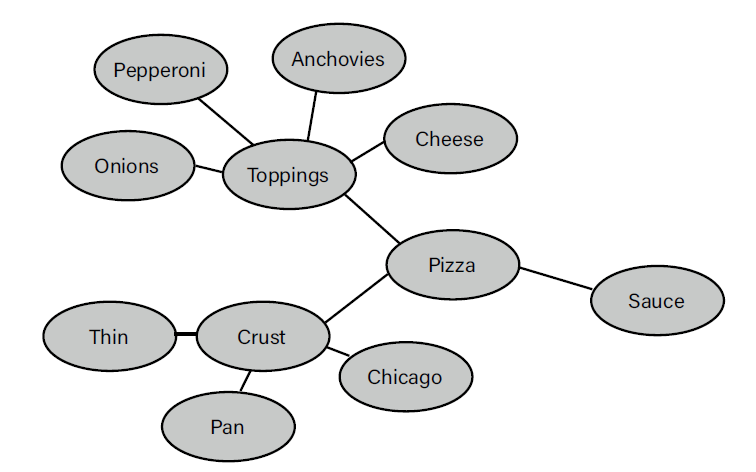
A mind map is like a brainstorming list, in that it is usually a quick, creative, method of committing ideas to paper. The difference is that a brainstorm is a list, and a mind map is a graphic, grouping ideas into concepts and linking similar concepts with lines.
Mind map for the topic of “pizza”
Questions
Questions can be used to guide further research, in which case we usually call them “research questions.” These may be related to what information you seem to be missing or what you need to know more about.
General questions can be effective, especially when just getting started. However, it is best as you learn more information to develop more specific research questions.
Research
Research can be informal or formal. Early in prewriting, it is usually best to do some informal research. Do a web search using some key terms from your topic. Search for your topic in Wikipedia or another general resource.
If you are writing a research assignment, however, it is best once you have some general information to then locate more specific sources.
Journaling
As we saw in the chapter on the reading process, journaling is really where the reading process starts to intersect with writing.
Freewriting
As described in the reading process, freewriting can be an effective method of applying free association to a topic. It can also be used in the writing process to further explore ideas. Note that freewriting is not the same as drafting. Drafting is usually much more organized than freewriting. If one were to try to turn their freewriting into a finished product, it would take a lot of revision and editing.
Networking
Just as with the reading process, you can gather a lot of perspective by talking to others about the writing process. Share your process. What are your goals? Your questions? What are your concerns moving forward?
Once you have enough information and feel like you have a good grasp on the topic, it is time to start working on the main point, or thesis.
Keep in mind that the writing process is recursive. You may find that once you have a thesis you need more information.
The thesis is the main stance or argument of the writing. In academic writing, it is often an argument of some form and should be able to be expressed in a single sentence. In other writing, you may have a main idea instead of a thesis statement.
Effective thesis statements
There is no singular idea of what a thesis statement should look like. The type of writing, audience, topic, academic style, and many other factors may influence the thesis. However, one effective method is to ensure that the thesis has a stance (or claim) and backing (support).
A stance is not just a topic. For example, a topic might be “global warming.” A stance would be something like “The average temperature of the earth is rising as a result of human activity.”
Note that a thesis is an argument on some level, not data. Data would be something like “Average global temperatures are rising at an accelerating rate in comparison to all prior climate data available.” One cannot logically disagree with this statement. The data does, in fact, show this trend.
Also, one must be careful not to craft an argument that is to obvious. For example, “Driving while intoxicated is dangerous.” This is an argument. However, almost nobody would disagree.
A stance is also never a question. There are rare occasions when a question can be used to stress an issue to make an argument. We call these rhetorical questions. However, a rhetorical question is only effective if the audience already knows the actual claim.
Thesis Statements
Sometimes thesis statements can be difficult to write.
Jazzy doesn’t fret about thesis statements though. When it comes to writing the main argument for an essay, Jazzy has the experience and know-how to write thesis sentences that pop!
Some things that you can do to write thesis statements like Jazzy are:
- First, be sure that you understand the writing assignment. If the topic is given, make sure your thesis fits within those given perameters.
- Don’t try to write a thesis until you have collected and examined your source material. If you don’t know what you are arguing about, then it is difficult to make an informed argument.
- Make sure your thesis contains a topic and position. Try the “Topic, Opinion, and Justification” approach. What is the main topic, what is your stance on that topic, and why is it important?
- Focus on details. If your thesis seems to be wordy and rambling or short and vague, take another look at the details. What does the reader need to know to understand your stance?
Once you have a thesis statement, then it is time to start working on the possible organization of the writing.
Some students say that an outline seems too constricting or that it dampens their creativity. However, unless one is writing creative works like poetry, earlier in the writing process was the place for creativity. Before you start drafting, you must get organized.
Drafting without a plan is like going on a road trip with a vague destination and no map: One may have a lot of fun getting there, if they show up at the destination at all, but they are going to waste a lot of resources doing so.
Paradigms
You don’t usually need to start from scratch in developing an outline. There are plenty of pre-determined organizational patterns you may use. Some common paradigms include:
Intro, Three Main Points, Conclusion: Often called the “five paragraph method,” this is a common paradigm because it is so effective. The three main points generally contain main arguments that support the thesis statement.
Problem/solution: As the name suggests, the body of the essay has two main points, each with many sub points. This can be an effective approach to policy essays, in which the solution for an issue is proposed.
Topical comparison: When comparing two concepts, texts, etc., you can do so by organizing the body around a few points of comparison.
Many more paradigms exist. Your instructor may introduce these. They may even be assigned for a writing project.
In business writing, there are numerous paradigms, depending upon what type of communication you are creating. For example, a letter of complaint generally contains an opening, a description of the problem, and an expected resolution.
Formal outline
There are many different possible approaches to outlining. Generally, you can be as informal as you like as long as you have a plan for the organization. However, in some situations, you will need a formal outline.
A formal outline is an effective approach to outlining, as it uses a hierarchical system, highlighted with letters and numbers, to show the structure of the planned writing. In addition, if an outline is assigned as part of your coursework, the instructor will likely want it to be highly organized, which is the hallmark of a formal outline.
Sample formal outline
A formal outline usually uses numbers and letters as well as indents to show the hierarchy of ideas.
- Introduction
- General topic
- Background information
- Thesis sentence
- First Main Point
- Topic sentence
- Supporting argument
- Cited support
- Explanation
- Supporting argument
- Cited support
- Second Main Point
- Topic sentence
- Supporting argument
- Cited support
- Supporting argument
- Cited support
- Third Main Point
- Topic sentence
- Supporting argument
- Cited support
- Supporting argument
- Cited support
- Explanation
- Conclusion
- Important points to remember
- Restated thesis
Drafting
Once you are done with prewriting and have a clear thesis and outline, now it is time to start creating the actual written work.
The most important point to realize when drafting is that you are not trying to create the perfect finished product. Drafting is a step in moving from an outline toward a finished product, but it isn’t complete.
When drafting, it may help to turn off editing and proofreading tools built into word processing programs. Focusing on getting words onto the page when drafting is made even more difficult if Word or Google keeps putting squiggles and lines under things while you are trying to type. You will have plenty of opportunities to revise, edit, and proofread later, but drafting is not the time for these.
Two of the most common approaches to drafting are very different. There doesn’t really seem to be a standard title for either of these approaches, but we can call them “top-down,” and “fill in the blanks.”
Both require a clear thesis and outline, but the approach to drafting is very different. You may feel like you have already used one of these approaches in the past. You may even have a preference. However, it is best if you can use both approaches to drafting and can implement either as the situation dictates.
Top down
In top-down drafting, you start with a clear thesis or main idea and outline and start drafting from the beginning by using the outline as a guide. The goal is to mostly concentrate on just getting the writing done, in order.
The top-down approach can be very effective for shorter writing assignments. It can be problematic, however, if the writing assignment is very long or complex, including researched writing with many sources.
Fill in the blanks
To use the fill in the blanks approach, it is best to have a very thorough outline, perhaps even a formal outline. In this approach, it doesn’t really matter where you start. As the name implies, the goal is to turn an outline into writing through adding details until headings and phrases start to become sentences and paragraphs.
The fill in the blanks approach can take a bit more work in prewriting. However, it will generally require less rewriting. This can be the best approach with large research projects, as it helps you to reinforce where you intend to bring in source material.
Often it is during the drafting phase of the writing process that writers may find themselves suddenly unable to continue writing with no logical reason for this dramatic change.
Writer’s block is not the same as procrastination. Procrastination is usually caused by one feeling so overwhelmed that they can’t even start a project. A common cause of this overwhelming feeling is getting so caught up in the creative concept of what something could be that a person can’t start because they do not have the skills or knowledge to reach the high expectations they have set.
The result of over-engaged creative thinking matched with little physical output is cognitive dissonance. One avoids the project because they don’t know how to scale their expectations back to something reasonable. They may fear failure because they know that the finished product can’t possibly fulfill their previously created expectations.
Writer’s block comes on after one has started the writing process. It is not usually avoidance behavior as much as an inexplicable work stoppage.
Causes of writer’s block
The specific reasons why one may suffer writer’s block are varied, but they can be categorized into four main causes:
Something else on your mind
Often, you may sit down to start drafting and can’t because you cannot concentrate on the task at hand. You may not even know what, specifically, is on your mind, but drafting is not it.
Unprepared
Quite often, writer’s block happens because you have not completed everything necessary in prewriting. You may even have a clear thesis and outline, but something isn’t right or is missing. When you get to this point while drafting, the process just stops.
Lack of confidence
Another reason writer’s block may occur is that you lack confidence in your ability to complete the process. Perhaps writing has been frustrating in the past or perhaps you are too critical of your own work.
Unfortunately, one of the best solutions for lack of confidence in writing is to practice writing, but this means you need to get past the current block.
The “yipps”
Sometimes one can be working just great, but then they become cognitively aware of what they are doing. They have a “flow” going, but suddenly they notice themselves, almost like another person looking in.
This is often seen in athletes who suddenly go from just doing what they are good at to overthinking it: A football kicker runs up to the ball with the wrong foot. A diver does a belly flop. A simple, fundamental, action suddenly has become difficult. They panic. They overanalyze it. They can’t seem to return to doing simple things correctly. They get the yipps.
When this happens, it can be quite difficult to quit thinking about how you are doing something and return to just doing it.
Solutions
The good news is that you generally don’t need to know why you have writer’s block to get through it. The following actions may help you to move forward with the writing process and finish drafting:
Start somewhere else
No rule exists stating that you must start drafting with the first sentence of the introduction and march forward from there in perfect order. In fact, introductions can be difficult to write. So, start with just the thesis at the beginning of the page and go on to the first body paragraph. Or start with the conclusion and then go back.
Often the simple act of typing gets us going. Also, this can help you see if something is missing in prewriting. If everything is going fine, but you get stuck in one spot, then it is time to go back to prewriting and develop a better plan for that section.
Type your outline
Again, sometimes the simple act of typing can get one going. Once the outline is typed, you should use that momentum and immediately start drafting.
Typing the outline can also help you see if there are potential issues. An outline that looks just fine when jotted on paper may suddenly appear to be disorganized when you begin to make the outline more formal.
Once the outline is finished, this may also be a good opportunity to switch approaches. Perhaps the top-down approach is not working, but the fill in the blanks approach would work better.
Take a break
A break is not a good solution for procrastinators. If you have waited until the last minute to start drafting, then taking a break is just further procrastination.
However, if you have planned your time effectively, taking a short break will help you to relax and come back refreshed. Often, people can be too close to a problem to see the solution, and a break is just the thing to provide some perspective.
Breathe
When under stress, people tend to stop breathing effectively. This limits oxygen to the brain and just makes it even more difficult to concentrate.
Sit up straight, close your eyes and breathe in through your nose and out through your mouth. Concentrate on the fact that you are breathing. Breathe from your belly. If only your chest expands, consciously ensure that your belly moves out when you inhale.
Freewrite
Freewriting can be an effective tool for getting past writer’s block. You should set a time limit and just write. If you can’t figure out what to write about, or stop writing, then write “I don’t know what to write” until the next thought comes.
The key is to not judge while freewriting. Just let it flow. There are no bad ideas while freewriting. This may lead to the discovery of what you are actually thinking about instead of drafting or may reveal an issue in the prewriting that is stopping the drafting phase.
Be careful, though. Freewriting is not drafting. You can use freewriting to explore ideas, but you need more structure when actually drafting.
Rewriting
Once you are done with drafting, the writing process is not done. Next, it is time to make the writing better.
Rewriting is a process of moving from large scale changes to small scale changes.
For rewriting to be most effective, it is best if you can take a break after drafting. When drafting, you need to see the writing project as a writer. In rewriting, you need to assume the role of the reader. You must be able to ask yourself “How does this read for someone who has never seen it before?”
Also consider printing the draft before rewriting. This way you can see things a bit differently and can make notes and editing marks to signal what needs to change.
The first step of rewriting is revision. In revision, you make large changes to things like the organization of the writing.
It is a good idea when making these changes to save the writing as different file names like Essay Draft 1, Essay Draft 2, etc. This way, if you decide later that you don’t like a major change then you can easily just go to the previous draft.
Overall, there are four actions you must take in revision: sharpen, delete, move, and add.
Sharpen your focus
First, check the thesis, or main point, and organization of the writing. Is the thesis a narrowed statement that takes a stance? Is the thesis clear to a reader who is previously unfamiliar with the writing?
Next, review the introduction and conclusion. Does the introduction ease the reader into the main idea? One should avoid gimmicky introductions in written work. While something like an intriguing question may make an effective attention-getter in a speech, in written work, the reader is already reading; they don’t need their attention grabbed. Keep in mind that the easiest thing for a reader to do is to quit reading. Anything that is confusing or off topic can provide an exit point that loses the reader.
Conclusions are another area that writers tend to overthink. The main role of the conclusion is simply to conclude the writing. One of the best ways to handle this in academic writing is to repeat the main ideas from the writing that the writer wants the reader to remember.
Delete
This step can be difficult for some writers. You have just created something in drafting that has likely taken a lot of time and effort. However, it is common to include information that doesn’t fit. Some writers tend to really get into the writing and “write long.” Some ideas that seemed like they would be effective in the outline may not work out so well when written. To be effective, you need to be willing to cut anything and everything that may not fit.
Cut anything that seems off-focus or unnecessary. One of the best ways to approach this is to force yourself to cut content. If you go into this step assuming there is nothing to delete, then you likely won’t find anything. However, if you make yourself find things to delete, the finished product will often be much better.
Move
The next step is to move text. You must be sure that the body of the writing fits the thesis. It is not uncommon for the writer to have developed an outline in prewriting that seems to work but does not adequately support the main point.
Losing track of the organization while drafting can be common, especially if one uses the top-down drafting method. You need to be willing to ask yourself if the organization could work better in a different order.
Some other common elements that may be enhanced by movement are examples and cited support. Often writers use support that seems quite interesting, but where it is used does not work so well. You must explore if the information would be more effective somewhere else.
Add
The last step of revision is to add text. You have made a lot of changes since the draft. The key is not to just add fluff but to add details. If it seems like the writing is too short, it is usually because you have not gone in-depth enough in the writing.
Where do you need more information? Do you need an example or cited material to help support a point?
Once you are done with revision, now you can move on to editing.
Editing is a slow, precise process. Therefore, it is best to get into the mindset that you are going to take the time to do what is necessary in order to improve your writing.
There are two levels of editing that must be completed: paragraph level and sentence level.
Paragraph level editing
In this step, the goal is to make each paragraph work better as a paragraph and to make sure paragraphs fit with the rest of the writing.
Topic sentences
Check to make sure that every paragraph has a topic sentence. A topic sentence is the main idea of the paragraph. Most paragraphs start with a topic sentence, but you can place the topic sentence somewhere else in the paragraph, as long as it is clear to the reader.
If a paragraph seems to have no topic sentence, then you have choices to make. Does the paragraph even belong in the writing? Could the content be moved to a different paragraph? Does the paragraph work well and just needs a topic sentence?
If a paragraph seems to have more than one topic sentence, the easiest fix is usually just to break up the paragraph into smaller paragraphs. This may require that each new paragraph is further developed to work better.
Transitions
The next necessary element is effective transitions. Often, it is best if paragraphs have tag statements at the beginning or end that help the reader to follow the organization. These could include phrases like “next,” “in addition,” or “last.”
Don’t overdo transitions in written communication. In a speech, one needs much stronger transitions. The audience is listening, so they need cues that something is shifting. In writing, one can see that a paragraph has stopped and a new one has started, so the reader is already expecting a transition. You just need to guide them to what that is.
Point of view
In any type of formal writing, the point of view must be consistent and appropriate.
Generally, you should avoid first person point of view (I, me, we, us, our, my) unless the topic is specifically about your experience. In MLA style, first person point of view is almost always avoided. In other styles, like APA style, it may be found, but usually in a limited fashion.
Overall, one should avoid second person point of view (you, your, yours) in any academic work. Second person point of view in written work can be confusing and distracting for the reader, as it seems like the writer is addressing the reader directly.
What this leaves is third person point of view. (he, she, they, it, his, hers, their, theirs, its).
In business writing, the inclusive “we” is often preferred. However, you do need to be careful to use pronouns correctly.
Tense
Another element of paragraph level editing is to check for appropriate tense usage.
One common mistake is a tense shift. This happens when the writer has been writing in, say, past tense, and suddenly shifts into a different tense, such as present.
For more information about tense, see section 8: Grammar.
Additionally, you must be aware of the appropriate tense for the type of writing and what you are referring to.
For example, in MLA style, texts (including any permanent or semi-permanent cultural artifact, such as books, recorded media, or even architecture) are usually referred to in the present tense. It is the stance of the Modern Language Association that texts, even though they may be very old, still exist and, therefore, are discussed in the present tense.
Other styles, such as APA, tend to refer to sources in the past tense. Therefore, one must be very careful of style when editing.
[For more about academic styles and editing, see the specific chapters for MLA and APA style]
Ambiguity
Be very careful with editing to catch any possible ambiguity in your writing.
One of the most common causes of ambiguity is improper pronoun usage. Pronouns (words like I, me, us, it, his, and their) must have a clear antecedent, or the word, usually a noun, that they are replacing.
Be very aware of a pronoun starting a sentence, especially at the beginning of a paragraph. This isn’t the only place where an ambiguous pronoun can happen but it is a common marker that the pronoun may be unclear.
Sentence level editing
Once you are done editing the writing on the paragraph level, the next step is to edit on the sentence level. To do so effectively, you need to look at each and every sentence and carefully look for errors in grammar or construction.
An effective method of doing this is to edit the writing backwards. This doesn’t mean that you should try to read backwards, but, instead, you should start by editing the very last sentence, then the second to last, and so on. This helps you to avoid the most common pitfall of editing, which is to just start reading instead of editing.
Some common errors to watch out for include incomplete sentences and agreement.
[Need to know more about editing? See Grammar]
Proofreading is a careful search for errors. These may include errors in spelling, typing, and punctuation.
Don’t just rely on your word processing program or an AI checker like Grammarly to check your spelling and grammar. Such programs can be helpful but often select items that are not an issue or even suggest solutions that are not appropriate or effective.
Homophones can be a particular issue when proofreading. Homophones are a specific type of homonym and are words that sound similar but are not spelled the same and have different definitions.
The present tense word to read (“reading”) and the noun that can be used to refer to a text that is assigned (“the reading”) are homonyms in that they sound the same and are spelled the same. However, they are not the same words. These can’t really cause a spelling issue.
The color “red” and the past tense verb to read (“read”) are homophones. They are pronounced the same even though they are different words and are spelled differently.
A computer program may be able to catch these issues at times, but not always, especially if homonyms are both the same part of speech. For example, “The gorilla attack was brutal,” or “The guerilla attack was brutal.”
In the first, “gorilla” which is usually a noun referring to a specific type of ape, has been used as an adjective. It means that apes attacked somebody or something. In the second example, the adjective “guerilla” refers to a type of sneak attack.
One final note about proofreading: Proofread everything! For example, often students may proofread the body of the essay very well and overlook errors in formatting elements like the heading or punctuation in the citation.
Peer Reviewing
One resource that you have available when rewriting is peer review. Peer review may be assigned for a class, or it may be something you want to set up yourself in a study group or amongst classmates, friends, or any other person who you trust to provide effective feedback.
Peer reviewing is important, not just because it can improve your writing by having someone else catch possible issues. Learning to review others’ writing can also help you to be more effective in revising, editing, and proofreading your own work.
To review others’ writing, there are a few basic steps one can take to make the process more effective.
Get into the correct mindset. Someone has asked for your help and has done so trusting that you will give the activity the time and effort that it deserves.
If you asked someone to peer review your work and they just gave it a quick glance and didn’t provide much meaningful feedback, you would likely think it was a waste of time. So, do for others what you would want them to do for you.
Ask the writer how they would like feedback. Is it best to print the writing and mark possible issues? Would they like you to make comments in a word processing file? Is there an app you should use to help peer review? Are you peer reviewing for a class and the instructor has a form or specific guidelines?
Also, ask what the writer’s goals are. What do they need from you?
Last, give yourself plenty of time to thoroughly read and reread and provide effective feedback.
As we saw in the previous chapter, rewriting is a very thorough process that moves from large, general, changes to small issues.
Keep in mind that rewriting is very thorough and time-consuming. Avoid focusing on little issues before you check large structural issues and then smaller editing-level needs. Also, don’t skip over a step. By the end, you may be getting tired of peer reviewing, but thorough proofreading is necessary.
Don’t actually rewrite
Although you should follow the rewriting process, resist the urge to just fix problems. You should make notes of possible issues. The writer is responsible for their writing; it is not your job to take that over.
Effective peer reviewing skills are important, but there are important skills in peer reviewing from the writer’s perspective, as well.
Be prepared
First, go through the rewriting strategies in the writing process yourself. Don’t hand someone a rough draft to review. If your draft is full of errors, then a peer reviewer will be overwhelmed and will not be able to provide all of the feedback necessary.
Be sure to choose your peer reviewer carefully. It may be easy to have your best friend or a parent review your writing, but they may not have the experience or be able to distance themselves from their relationship with you in order to give effective feedback.
If you are peer reviewing for a class, you may have no choice as to who is reviewing your work, but you can follow the guidelines in this chapter to make the process more effective.
Also, share your goals with your peer reviewer. What are you most concerned about in the writing? Do you have any writing habits, such as writing in far too much detail or grammar errors like tense shifts that they should pay particular attention to? Also, be sure that the reviewer has the directions for the assignment so they understand the assigned parameters.
Give your peer reviewer plenty of time. If the assignment is due tomorrow morning and you ask someone to review it tonight, then they will be rushed, and you will not have enough time to make possible changes.
What to do with the feedback?
Once your reviewer is done, be sure to look over their comments. If you need any clarification, ask the reviewer.
Don’t forget that you are the writer and you are ultimately responsible for your writing. If a reviewer has suggested changes that you disagree with, then you need to make a choice. Are you uncomfortable with the suggestion because it is incorrect or are you uncomfortable because you are too dedicated to the original to see the need for change? There is no right answer for this. You must make the best choice.
Also, don’t overlook clarifying with your instructor if there is anything that your reviewer has suggested that you disagree with. The instructor is the person most familiar with the assignment and can provide the best guidance.
Once you have made any necessary changes, edit and proofread the writing one more time. Any changes made can cause cascading issues within the writing, so you need to catch any problems.