In academic work, we quite often need to locate source material.
Depending on the situation, research can take many different forms. For example, in a lab class, the work done in the lab is often primary research. A lab report is often completed in order to document what was done and what one has learned from this work.
Similarly, in a literature course, a student may be asked to write a response to something read for class, such as a poem. In this case, the poem is the primary source. It is not enough to just read the poem, however. To prepare to respond, one must go back through the poem carefully to select exactly what they should write about and then plan a response.
On the other hand, a research essay for a course may require very in-depth research, including extensive time spent locating articles from journals and websites and possibly even locating appropriate books. After such sources are located, one must then read the sources quite carefully, take research notes, and begin to plan how to use the source material.
In this section you will learn:
- The difference between primary and secondary sources
- How to evaluate source material
- What lateral reading is
- How to avoid bias in your research
- The impact that plagiarism has on your writing and your academic career
- How to use library databases to locate source material
Resources
At the heart of it, research is all about sources.
Although one can certainly write about their own experience by using themselves as a source, most writing situations in academics require other source material.
Generally, primary sources are what you are writing about. Secondary sources are materials used to support your writing.
Some textbooks will list the types of sources that are likely to be primary sources. However, this can create confusion. Whether or not a source is primary or secondary has much more to do with how the writer intends to use it, not what, exactly, the source is.
For example, a student may be asked to read an article and analyze how the writer developed the article. In this case, the article is the primary source. It is the source that is being analyzed.
However, if the student has been assigned to analyze an issue, then material from this same article may be used to help support the student’s analysis. In this case, the article is a secondary source.
Deciding if a source is primary or secondary early in the research is important, as this decision affects what kind of information the writer needs from that source and what other sources may be necessary. Often, guided experience in using sources is the best way to learn these differences.
To make research more effective and improve how we use source materials, it is important to understand how to evaluate sources.
Not all source material is created equally, and a source that may be appropriate in one situation may be ineffective in another situation.
All forms of media may contain poor material created by people with questionable intentions. Groups with political and financial interests have learned to hijack the media that we rely on. Organizations may use language that seems professional and even academic to promote biased material. Corporations sometimes create organizations with names that are very similar to other, non-biased, organizations with the aim of swaying public opinion. Social media posts are created by foreign government bots to influence people. And AI generated content is sold as art and literature to make their creators some quick cash.
Another issue is website titles that are created specifically to catch trending searches. Most of what you may try to search online in completing coursework is probably fairly common for other college students. Unreliable content creators will often use common search terms to create a title that gets high results in a search engine.
Also, it is easy to be fooled by slick design. Just because a source looks like it is professional, with a good-looking logo and an easy-to-read layout, doesn’t mean that it is a reliable source.
In an age where everyone can post their opinions and reach an international audience with no critical thinking at all, it is up to the consumer to evaluate material carefully.
Look closer
One trick many unreliable sources use is to create websites and even publications with titles that seem reliable. For example, just because the word “journal” is in the title does not make a source reputable.
Using a library database to search for source material can be one method of avoiding some bad actors. However, evaluating the source for its appropriateness to your intended use is still important.
Take the time to take a closer look at the source. Does it have a sponsoring organization? If so, look up that organization. Once again, be aware that some unscrupulous people create organizations that have reliable sounding names when their intentions may not be clear.
An organization being non-profit means very little in regard to the quality of their material. We often think of non-profits as organizations that exist to help needy people, but the term “non-profit” only means that the organization meets certain tax guidelines. They may give funds away to other people or organizations, but it is important to know who is actually getting that money.
Domain extensions of web addresses are not a good indicator if the source is reliable or not. Addresses ending in “.com” may or may not be reliable. Companies selling products may use “.com,” but so do many reliable publications. The domain “.org” doesn’t really mean anything, as the rules for having a “.org” domain are not very strict. Even the domain “.gov” can be misleading. It is reserved for official government offices, but government offices publish, revise, and remove content based on political whims.
If a website is run by a single person, be very careful. Anybody who can pay for a domain name and webhosting can create a website. Without anyone else checking their content, there is a very real possibility that it will be unreliable.
If a source seems to have existed for some time and has a variety of content authored by a variety of authors, this is the start of a good sign. If the publication has a link to the editors for the source and there is some explanation of the hierarchy of how the publication is managed, then it is more likely to be reliable.
Language
One effective method of evaluating source material is to pay special attention to the language used.
Specifically, watch out for language that is inflammatory or emotionally charged. Notice if sources engage in name calling and/or usage of slang words instead of formal terms. Reliable sources usually try to avoid such language.
Also be aware of language that seems overly formal, especially in writing situations that would not require it. A research study published in a journal will likely have a very high level of diction. However, something informal like an article on a website usually won’t. Odd word choices such as rare words used in place of more common terms may be an indicator that something has been created by generative AI.
Often, sites operated by special interest political groups or by commercial entities will use tricks like bragging-up how often their source material has been shared or how many hits their site gets. A reliable source doesn’t need to do this.
Last, look out for poor grammar and spelling, and writing that has many errors, overall. If the writer has not taken the time to edit and proofread the writing, then they likely have not taken the job very seriously.
Lateral reading
You can learn more about a source by examining it more closely (what is often called “vertical reading”). However, this may not give you enough information to determine if the source is valid.
Lateral reading is research you do about the source by looking at other sources. The best way to do this is to research as you read.
An easy method of lateral reading is to keep a browser tab open on your computer while you read. The very first things you should research are the publication (unless you are already familiar with it) and the author.
Look up the publication or site. First, just do a web search. If other sources seem to have almost the exact same information about the source, then this can be an indicator that the original source has paid to have positive reviews created.
If other sources generally have bad reviews of the source, it is also likely to be a poor source. And, if the source doesn’t seem to get any mentions anywhere else, then this is highly suspicious.
Next, look up the author of the article or content. An author who doesn’t seem to exist outside of the content you are looking at is a very bad sign. Also be aware of authors with very limited content or content that all seems to be related to the same website or publication.
If an author has multiple other works published over a span of time and seems to exist somewhere other than on a particular website, then they may be reliable.
Also, once you learn to use the lateral search method, it can often be completed in a matter of minutes, while you could troll through a single website for hours trying to determine if it is reliable.
You can also use lateral reading to check terminology you don’t know and to quickly look up sources that have been cited. If a source that looks like it is reputable uses sources that are biased or inflammatory, then you know that the source you are reading is also biased.

When completing research, it can be difficult to know if a source is reliable or not. However, Jazzy doesn’t fret because Jazzy knows that lateral reading can help us determine if a source is valid.
For example, when researching the impact of AI on the environment, Jazzy finds an article on the World Economic Forum (WEF) website.
Jazzy knows the importance of lateral reading and finds on Wikipedia that the WEF has been an organization since 1971. Jazzy also discovers that, although the website has articles related to business and industry, the WEF is mostly known for their annual meetings of business leaders.
A quick web search for news articles about the WEF is not as helpful. Jazzy is concerned because it is a bit difficult to find independent articles written about the WEF. Business publications have articles about the WEF, but most seem almost exactly the same. Jazzy knows that this means that they were all likely written from the same press releases from the WEF.
Jazzy does find a couple of articles that feature the roll that international politics has played in recent WEF meetings.
Given that the WEF is a long-standing organization and the content of the article clearly relates to the relationship between business leaders, AI, and environmental concerns, Jazzy decides to use the article for background information. Jazzy will use what is learned to locate sources that feature original research or more nuanced reporting.
Ethics
Being ethical when using source material is very important. Ethics can take many different forms, such as being aware of bias, avoiding misconstruing information, and citing source material properly.
No matter how much source material you use, if it is used unethically, then the whole point of writing in academics fails.
The inclusion of writing projects and assignments in education is purposeful. Instructors certainly don’t assign “busy work” that isn’t meant to teach, reinforce, and/or assess student learning outcomes. No instructor wants to grade all of that work if it has no purpose.
When a student enrolls in a course, they enter into an agreement to learn the material and to demonstrate what they have learned. This agreement is stated in some way in documents like the student handbook and the course syllabus.
Therefore, any attempt to shortcut that agreement is an ethical issue. In addition, unethical usage of source material breaks societal norms that affect the writer and others.
Bias may affect research in a couple of ways. Publications and content are often created by people and organizations with their own goals in mind. It is important, then, to avoid source material that has an obviously biased intent.
The other side of this is your own bias.
We all have bias. We have wants and needs and experiences that color our world view. The key to effective learning, and research, is to limit the extent that bias plays in locating and using source material.
Confirmation bias
In research, it is very easy to give more attention to sources that uphold what we already think or know while ignoring material that contradicts our predetermined ideas. This is confirmation bias.
One way in which confirmation bias can enter our research is when we decide on a thesis argument before conducting the research. If you settle on your thesis first, then instead of researching the topic, what you do is research sources to support your thesis, ignoring any information that doesn’t confirm that your predetermined stance is correct.
To help avoid confirmation bias, follow the writing process. Concentrate on well-constructed research questions early in the process. Then, conduct your research, or at least most of your research, before settling on a main argument.
This way your argument is informed by the research, not the other way around. Keep in mind that just because you disagree with a source does not mean that the source is wrong.
Anchoring bias
Similar to confirmation bias, anchoring bias can affect our ability to evaluate source material. However, anchoring bias is created by a tendency for us to give more weight to the first source or first information we have and compare all other information to that.
It takes practice and some keen critical thinking skills to avoid anchoring bias. One method is to actively work to evaluate each source on its own merits before comparing it to other source material. Effective research note-taking skills are related to this skill.
Cognitive dissonance
When faced with new or contradictory information, a natural reaction is to feel discomfort. This feeling can lead us to ignore information in order to avoid being uncomfortable. This is cognitive dissonance.
Cognitive dissonance may play into our research in many ways. The style of writing or level of diction of a source may be confusing or overwhelming. The subject matter may be completely foreign to us. Also, the topic of the source can make us uncomfortable. It can also happen when source material contradicts our pre-determined ideas. We don’t like to think that we may be wrong. All of these can lead to cognitive dissonance.
Effective critical thinking and reading skills are essential tools when completing research. This requires the ability to tolerate discomfort but also the ability to note that we are uncomfortable and analyze why.
Also, two or more ideas can be true, even if they seem to be contradictory. Avoiding either/or thinking can help us to be more open to the complexities of an issue.
If you find yourself having a strong reaction to source material, such as dismissing it as just being bad or poorly written, take a moment to analyze your reaction. Are the arguments or writing not well done, or are you having a reaction to it because you find it to be confusing or contradictory? As with confirmation bias, just because you disagree with a source or it contradicts what you already know or believe does not make the source wrong.
One of the most common ethical issues in research is plagiarism.
Plagiarism is using source information without giving proper credit.
This definition has two important parts. First, “using source information” may mean many different things. Not only do we need to be sure to acknowledge sources used for quotations, in which we have used the source material word-for-word, but we must acknowledge sources for any information. This could even be a concept or a summary of an idea.
Ideas have value. To use someone else’s intellectual property and not give them credit is theft.
The second element in the definition of plagiarism that we need to focus on is “giving proper credit.”
How we give credit varies greatly, depending on the context of how it is being used. In some forms of writing, a casual reference to the source may be enough. In academic writing, one usually must use a standard citation style. This includes both in-text citation with the source information and a references page of some kind (called a Works Cited page in MLA style or a references list in APA) with the full source information.
Common knowledge
If information seems like the sort of thing that everyone should know or that the writer feels like they “just know” and may be unaware of the source then it can be difficult to assertain if it should be cited.
The MLA Handbook, 9th ed. states that one does not need to cite information if it is commonly known to your audience or if it is historical information that is commonly agreed upon.
This means that “common knowledge” is relative: There is no universal information that fits the definition.
For example, at a Comic-Con, one can assume that the audience knows that the characters of Thor and Superman do not usually appear together, as the characters belong to two different media companies. Wonder Woman and Superman, on the other hand, appear together in comics all the time, as both are DC characters. The relationships between these characters is common knowledge.
The average person on the street may find all of this to be quite confusing. For them, relationships of comic characters to each other are likely not common knowledge.
Even historical information can be relative. For an American audience, the fact that the Salem Witch Trials occurred in Massachusetts in 1692 and 1693 would be considered common knowledge, even though most Americans could not accurately give the dates. There is no reasonable argument that they happened at some other time or in some other place.
The details of the trials are also well documented in the historical record. However, they are not well known and are commonly misconstrued, so they would need to be cited for most audiences.
The issue, then, is how to know if your audience already knows the information. Unless you can say in all certainty that your audience will know, then cite it.
Databases
Research databases can be extraordinarily helpful research tools.
Many research databases are managed by organizations that buy the rights to reprint source material and then sell access to libraries and individual users.
This is superior to trying to locate sources in a browser search. Others have already evaluated the publications contained in the database, and you can access publications that would usually require a fee or subscription.
For detailed instructions on accessing and using your library’s databases, you should visit your library’s website. In general, however, there are some key tips for effective database usage.
Many specialized databases are available. For example, the Education Resource Information Center (ERIC) is a database managed by the United States Department of Education. As the name suggests, ERIC mostly carries research related to education topics.
Other databases are quite expansive. The Academic Search Premier database, available from EBSCO, is a multi-disciplinary database and carries articles related to many academic areas.
Searchable technology, such as a web browser, streaming service, or social media platform, uses algorithms (guidelines in the form of logical processes represented by mathematical formulas) to assist when someone is searching.
Databases don’t publish their algorithms, as they are closely guarded industry secrets, but there are some things we can do when searching to make better use of the algorithms to get more effective results.
Use keywords to search
Avoid asking questions. For example, rather than typing What is the tallest building in the world? in a database search box, simply type tallest building world.
Keep phrases together
Use quotation marks to limit the search to that phrase. For example, a search for Greek tragedy would also include results for sources that have the term Greek and the term tragedy independently. When looking for materials about the works of Homer, one doesn’t necessarily want a story about a gyro mishap. A search for “Greek tragedy” treats the full phrase as one unit.
Use advanced phrasing
To combine terms, use and. If you are in a psychology course and researching Maslow’s Hierarchy of Needs, you could use “Maslow’s Hierarchy of Needs” and psychology to limit your search to those sources that take a more psychological approach to Maslow, as opposed to other approaches. And will result in fewer sources.
To combine terms and get more results, use or. For example, if you are researching mathematical instruction and know that counting and grouping are important early math skills, you could search for counting or grouping and get results that include counting, grouping, and both counting and grouping. Or gives you more results.
Refine or filter results
Databases commonly include checkboxes or other tools that can quickly help you to limit the scope of your search.
Full Text: If you do not limit your search to full text, you will also get results that only provide citations or abstracts for articles that you must find someplace else, which isn’t very handy if you are a student on a tight schedule.
Scholarly Journals: These publications are usually published by colleges and universities, or other organizations that are mostly dedicated to academic research. The focus is usually on a very specific topic and the intended audience is usually people studying these topics, or similar ones.
Peer Reviewed: Unlike articles from general interest magazines and websites, peer-reviewed articles are evaluated by experts prior to publication.
Date: Limit your search to a range of dates to best fit your needs.
Source: Allows you to select if you only want information from certain types of publications such as websites, magazines, newspapers, or video.
Advanced search
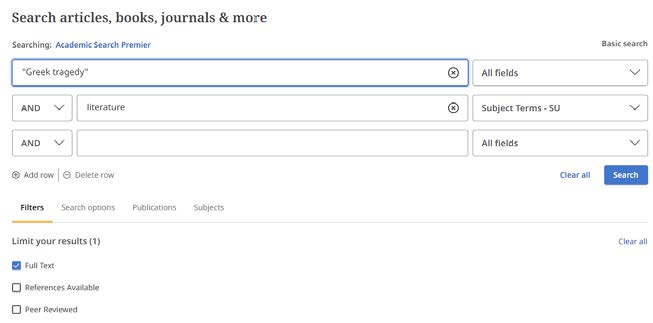
If you are looking for more than one keyword or phrase, or if you find that you are getting too many results or results outside the scope of what you are trying to research, use “advanced search” to open more search boxes.
You can then limit what each box represents in the search.
For example, if you are looking for articles about ancient Greek tragedies, you could use advanced search and put “Greek tragedy” in one box. Then, in the next box, type literature and limit that search as a subject search. This way, you would only get those sources about Greek tragedies that have been listed under the subject of “literature.”
Example of an advanced search in EBSCO