An argument is an exchange meant to lead to a common outcome.
Seeing this definition of argumentation in practice can be difficult. Activities that often employ argumentation techniques, such as competitive debate, political discourse, or legal proceedings, seem to be all about winning.
One can certainly learn a lot about argumentation by participating in competitive debate or practicing law. However, these activities largely borrow the techniques of argument for other purposes.
The issue is that it is easy to abuse the concept of argumentation while not actually making an argument.
The point of argumentation is to convey a clear message that is logically sound. Persuasion is one application of argumentation, but the emphasis of persuasion is to change someone’s mind. Debate is an activity that uses concepts from argumentation with the intent to win.
An argument may not even ask the reader to adopt a stance or change their mind. An argument may be as simple as finding agreement that a condition exists, or that something fits a certain definition.
Understanding argumentation techniques helps us to see issues in other’s arguments, but it also helps us to avoid those same issues in our own.
In this section, you will learn:
- How Aristotelian logic can help us form more effective arguments
- The difference between inductive reasoning and deductive reasoning
- The basic elements of a stasis approach to argumentation
- How a Rogerian argument can help you to better connect with an audience
- The four main parts of Toulmin’s model of argumentation
- How Maslow’s hierarchy of needs can help us determine an audience’s motivation
- What fallacies are and how to avoid them
Aristotelian Rhetoric
Aristotle was a Greek philosopher who lived from 384-322 BCE. He is well known for many contributions to areas as vast as mathematics to biology.
His lectures have provided the modern name for the study of argumentation: rhetoric. The basic ideas of his lectures have also formed the basis of almost all study of rhetoric in the western world.
Aristotle argued that there are three main elements to rhetoric: logos, pathos, and ethos. None of these are considered more or less important than the others. Instead, all three must be represented for an argument to be balanced.
Logos is using logical structures in an argument. This could include using pre-determined logical structures, some of which are covered later in this handbook. However, this could also mean just making sure that one is being logical, overall.
“Path” is a Latin root that means emotion. Pathos, therefore, is carefully using emotion in an argument.
Often there is a misunderstanding that argumentation has no room for emotion. This is just wrong. We need to use emotion to connect with the audience. We can even use emotion to sway an audience’s ideas. However, we must be very careful to do so ethically, which brings us to the third component of Aristotelian arguments.
The word “ethos” has the same Latin root as “ethics” and for good reason. Ethos is being ethical in your arguments. This can take many different forms:
Being ethical in our dealings with others
It is not morally acceptable to manipulate people or to cause them harm. When making an argument, we must do so with the audience’s best interest in mind. If the audience feels that we are helping them, or in the very least, not taking advantage of them, then our arguments will be much more effective.
Avoiding fallacies
Fallacies are basically arguments that don’t work for a variety of reasons. In this way, logos and ethos intersect, as we want to make arguments that are structurally correct. We don’t want to knowingly make mistakes or poor arguments.
Using cited support
Most of us are experts on very little. When we make arguments, we need the support of experts to help us. By citing source material, we can borrow someone else’s expertise and make better arguments. Using multiple sources shows that we have considered other ideas. Also, when the reader sees that we have given sources proper citation, it shows that we are ethical people.
Inductive arguments are those that move from a specific observation to a generalization. Deductive arguments move from a general statement to a more specific statement and then end with a specific conclusion.
Understanding inductive and deductive arguments can help us to form better arguments and analyze other’s arguments. However, neither works very well on its own as a complete argument.
Induction
Imagine that you have a cloth bag that is full of something quite heavy. You stick your hand in and pull out five pennies. From this, you conclude that this bag must be full of pennies. This is inductive reasoning. You have moved from a specific example (five pennies) to a generalization (a bag full of pennies).
For an inductive argument to be effective, the example used in the first step must be apt. For example, one penny pulled from the bag is not enough to say what the rest of the bag is full of.
Also, the conclusion of the inductive argument must be valid. In our bag example, we didn’t come to a conclusion about all mystery bags, just this one. We also aren’t making an argument about all pennies, just that this particular bag is full of pennies.
Inductive reasoning is not just limited to sampling, although it can be very helpful when dealing with a survey or study. Induction also works with matters of probability. However, we can also apply induction to larger arguments.
Studies have shown that students from low-income neighborhoods are less likely to finish high school. From this, we may conclude that there is an inverse link (as one goes up the other goes down) between poverty and educational attainment.
Notice in this example that the result isn’t a guarantee. Induction works to check our logical construction of an argument, but it doesn’t mean that it is correct 100% of the time.
Another issue can be assuming a fallacy of false causality. The act of pulling pennies from a bag did not cause the bag to be full of pennies; somebody clearly filled this bag with pennies before we started guessing what was in it. Also, poverty does not cause students to leave school. There is a correlation, or relationship, between poverty and completion of high school.
Also, we must note that an inductive argument mostly works best on matters of probability. We cannot guarantee the truth of the generalization based on the initial sample. If our mystery bag is dumped out and one nickel is found among hundreds of pennies, this does not mean that our inductive argument was poorly constructed; it just means that induction cannot possibly account for all possible variables.
Deduction
A deductive argument uses two general arguments called premises. Usually, one premise is a larger generalization, and the second is more narrowed. These, then, lead to a logical conclusion.
In a deductive argument, if there is a reasonable relationship between the two premises then the truth of the premises ensures that the conclusion is true.
In this course, any score between a 90% and a 100% is an A.
I earned a 93% on my last essay.
I earned an A on my essay.
Although deduction can help us to logically work out a problem, it cannot reveal anything that isn’t already known in some way. In other words, deduction can help us check our thinking, but one must already know the facts of an issue to create the premises.
Also, unlike induction, deduction isn’t very helpful in matters of probability.
In Nebraska, it usually snows in January.
Next month is January.
Therefore, it will snow next month.
This syllogism is logical, but, as anyone who has lived in Nebraska may know, has little to do with the real, observable, outcome. Most years there is snow in January, but weather patterns can vary, and some years Nebraska has a January with no snow. Deduction is not very effective at revealing an unknown, like the future.
To go back to our mystery bag problem, a deductive argument may look something like:
Bags can hold things.
Pennies are things.
Therefore, this bag is full of pennies.
Notice in this example that we now have an issue that we did not have in using induction. Deductive arguments don’t work very well for situations in which we could just confirm something through direct observation. Given the premises, there is no way one could argue that the bag is full of pennies. The problem is that many things are also “things.” In this case, the second premise is unsound even though it is true.
Stasis Theory
Another common approach to argumentation that is rooted in ancient Greek culture is stasis theory. Stasis means balance. In a stasis approach to argumentation, the goal is to balance all the information before proposing action.
A stasis approach to argumentation includes four parts:
- State the facts.
- Define what happened.
- Explore our values.
- ropose a solution.
Discussing facts as arguments may seem odd, but facts are different than data. Data with no context are not arguments.
For example, one may walk into a room and see their partner’s dirty socks on the floor. The dirty socks on the floor is a datum. One cannot possibly argue that the socks are not on the floor, as direct observation confirms that they are, indeed, on the floor. One may say “Your dirty socks are on the floor,” implying that they would like the socks picked up, but just announcing that socks are on the floor doesn’t actually make an argument.
If one argues that their partner has left their dirty socks on the floor, now we have an argument of causality, which is an argument of fact. A person has acted in such a way as to put their dirty socks on the floor. If one argues that there are dirty socks on the floor despite their numerous requests for stinky socks to not be laying around, then this is an argument of correlation. The socks on the floor are in relationship to a previous conflict about socks.
Data is an important part of this first step, but we need more than just observable phenomena; we need an argument.
Definition arguments are quite important. It is one thing to know that something exists and even how or why it exists, but to help us make sense of the world, we need to define it.
In the case of our socks issue, one could argue that this dirty sock misplacement is inconsiderate. The partner has not taken others’ feelings about the dirty socks into account.
Values can be tricky arguments to understand, because they can often seem like definitions. To make value arguments, we must explore what we hold to be valuable and important. Value arguments tend to be ones of degree. How good or bad is something?
In the case of the dirty socks, we have defined that leaving the socks on the floor is inconsiderate, but how inconsiderate is it? One could decide that a pair of dirty socks on the floor is not really a big deal. Or perhaps it seems like it is indicative of larger issues in the relationship and is a really massive betrayal.
Once we have fully explored the first three steps of stasis theory, now we can decide how to best respond. The whole point of the stasis model is to help us avoid jumping to conclusions.
In the case of the dirty socks, if one did not go through the first three steps, they may overreact in a way that is inappropriate to the situation and cause larger issues. However, they could also underreact and just pick the socks up for the other person, enabling their inconsiderate behavior. Perhaps, after going through stasis theory, one could decide to ask their partner to please pick up their dirty socks, as it is inconsiderate to leave them on the floor.
The key to stasis theory is that it doesn’t tell us what to do. Instead, it helps guide our thinking.
In order to arrive at outcomes that are agreeable to everyone, it is important for the writer to understand the audience’s position on a topic.
This does not mean that the writer should just change their position to match somebody else’s stance. In any conflict, there is something everyone can agree upon. It may be difficult at times to find that common value, but it is key to making a successful argument. The writer should build upon shared values when forming arguments and form arguments that the reader will likely accept.
For example, in the case of bike lanes, if a group wants their local city council to install bike lanes, others may disagree for many different reasons. They may not like the cost of concrete work and line painting to create bike lanes. They also may not appreciate the impact that reduced space for driving and/or parking of cars may have on them. People may even have negative reactions because they see bike lanes as an example of a particular political agenda.
However, what most people do value is safety, especially the safety of children.
So, if those who want bike lanes stress increased safety for bike riders, pedestrians, and auto drivers, alike, then they are more likely to bring detractors of bike lanes to their side.
Rogerian arguments can be incorporated into other models of argumentation. It is best for the writer to always be aware of their audience and create arguments that best reach that audience.
Toulmin’s Model
Toulmin’s model is a modern take on argumentation that builds upon other ideas about arguments, such as classical Greek argumentation.
By applying this model, we can create more effective arguments. The model can also help us analyze others’ arguments.
Toulmin’s model contains four basic parts. Each has specific roles and relationships to each other. These are the claim, support, warrant, and qualifier.
Often, the model is constructed in such a way that the claim is derived from the available support.
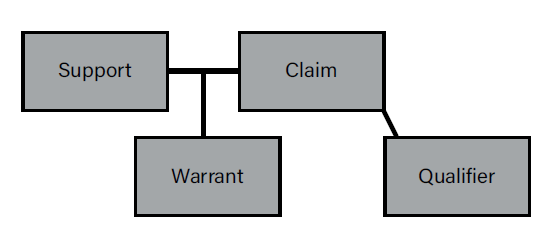
However, it may be more helpful to think of the model the other way around, as the claim is the main part of the argument.
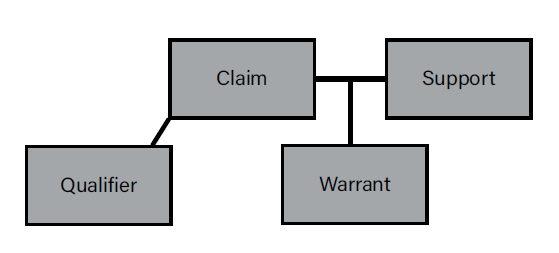
The claim is the position or stance of the writer. All of the other elements in Toulmin’s model are in relationship to the claim.
Central Park in New York is a well designed public park.
This is a claim of values. It argues the extent or degree of something, or how we feel about it.
Support is attached to the claim and, as the name suggests, supports the claim. A claim on its own is a weak statement and doesn’t make a very effective argument.
There are two types of support: Evidence and Reason.
Evidence can be data or personal testimony. Evidence is not, however, an argument.
Central Park was originally outside of city of Manhatten and most visitors explored the park by carriage in day-long excursions.
This statement has two bits of evidence. The park was not within the city and usually took a carriage ride to enjoy the park.
Reasons (sometimes called appeals) are further arguments to support the claim. These can be further described using Toulmin’s Model since they are arguments. They have their own claims, support, warrants, and qualifiers.
The Victorian principles of its creators made Central Park largely inaccessible to the working class.
We can see that this reason would require further argumentation to show just what those “Victorian principles” were and why this caused the park to be inaccessible for many people.
The warrant is the logic that holds together the claim and the support. As we can see in the model, it is not attached directly to either the claim or the support. Instead, it is what connects the two.
Warrants often go unstated. When this is the case, we may call this an assumption. However, in more complex arguments like a speech or essay, we do need to explain why the support logically belongs with the claim.
Central Park wasn’t always a well-designed park, as the Victorian principles of its creators made it largely inaccessible to the working-class.
The unstated logic is that parks that are not accessible to everyone are not well designed.
Sometimes it can be very difficult to decide what the warrant of an argument is, but this is an important step. If the support does not logically connect to the claim, then this creates any number of fallacies, which are incorrect or incomplete arguments.
Qualifiers modify claims. It is important to note that this is a major difference between Toulmin’s model and Aristotelian argumentation. Aristotelian argumentation tends to be most helpful when dealing in absolute terms, but Toulmin recognized that this is not always how arguments work.
Qualifiers can limit the scope of a claim or propose specific conditions for when the claim would be true.
One famous example is from the Declaration of Independence,
When in the Course of human events, it becomes necessary for one people to dissolve the political bands which have connected them with another, and to assume among the powers of the earth, the separate and equal station to which the Laws of Nature and of Nature’s God entitle them, a decent respect to the opinions of mankind requires that they should declare the causes which impel them to the separation.
Perhaps people don’t always need to “declare the causes which impel them to the separation,” but the qualifier is that under the conditions given before this claim, they should.
Maslow’s Hierarchy of Needs
Maslow’s hierarchy is not a model of argumentation. It is a psychological concept that helps to explain human motivation. This model can be used to help us to better support arguments by aligning support with the reader’s needs.
Abraham Maslow was a humanist psychologist in the mid twentieth century. His work is largely in opposition to Freudian psychology, which often analyzes what motivates people by looking at their subconscious needs and wants through the lens of disfunction. Maslow was seeking, instead, to describe people’s motivation by their current situation.
In his research, Maslow was impressed by the great lengths that some people will go to in order to reach their full potential, which Maslow labels as self-actualization.
Since Maslow’s creation of the hierarchy, many pop-psychology texts have claimed that by following some specific system that one can become self-actualized or their “best self.”
However, Maslow never made this claim. He argued that very few people are self-actualized or will become self-actualized. A person is not dysfunctional in some way because they are motivated by other needs. The model describes motivation, not self-improvement.
Maslow’s hierarchy of needs is often shown as a model of a pyramid with the basic needs toward the bottom, psychological needs in the middle, and self-actualization at the top.
What is important to remember about this model is that a person is motivated by the lowest level on the model that feels threatened in any way. Once a person feels secure in that need, then they are motivated by the next level up on the model.
For example, a middle-aged person who is middle-class and who has been in a long-term relationship for some time may be motivated by esteem needs like recognition at work and the respect of their peers. However, if there is a natural disaster and they find themselves in a damaged home with no power and food supplies running out, they will be primarily motivated by physiological needs.
In such a situation, one may risk their own safety in order to secure those physiological needs. They may go as far as looting a nearby grocery store. They would never consider robbing a grocery store any other time, but the immediate threat to their physiological needs is their primary motivation.
The exception to the up and down nature of Maslow’s model is self-actualization. Maslow noted in his research that a very small number of people, usually older people that have had a long life of experience, seem to be more motivated by their service to others.
This is easy to confuse with esteem or social needs, but the difference is the motivation. Those who strive to make the world a better place may do it for their family and friends or for recognition. A self-actualized person’s motivation is generally the intrinsic reward of just doing the right thing.
Maslow’s hierarchy of needs
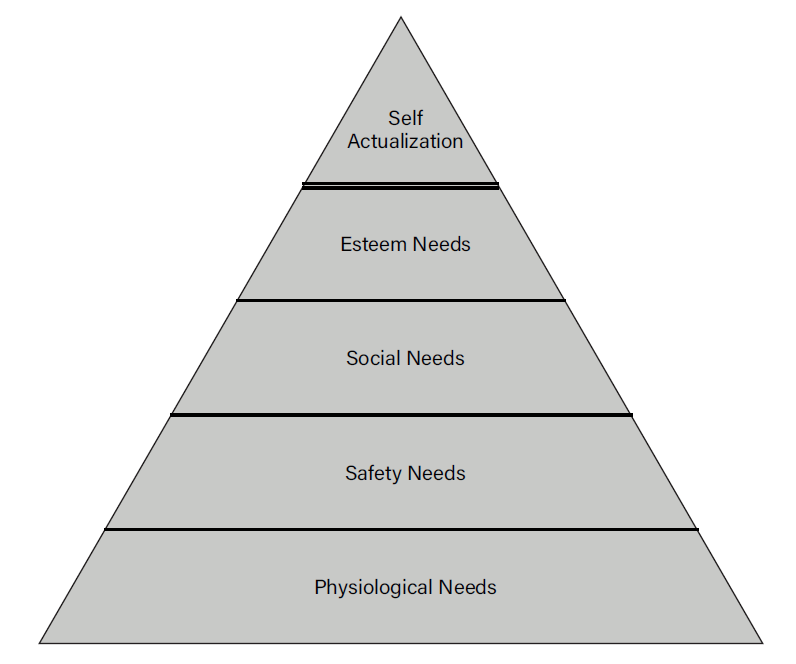
In applying Maslow’s hierarchy to argumentation, it helps to think of it in terms of how it fits within Toulmin’s model. A writer must be able to align support for a claim with needs that best fit the audience.
In the example of bike lanes, we already saw in Rogerian arguments that most people value safety on some level. However, this may not be their primary motivation. For example, most people who would run for a local political position, like a city council member, are more likely to be motivated by social and esteem needs. We would like to think that these elected officials are self-actualized and mostly motivated by making the world a better place, but self-actualization is rare.
So, if a group is presenting an argument to their local city council that there needs to be funding made available to develop safe bike lanes, the best support for this would be arguments that would affect people motivated by esteem or social needs the most.
One way to do this may be to stress how much the community would appreciate their council members prioritizing the safety of the community. Another may be to have the council members visualize their own children or grandchildren trying to cycle on a dangerous street or busy sidewalk.
Fallacies
Fallacies are essentially broken arguments. They can occur for many reasons, so it is very important that we learn to recognize them in other’s arguments as well as in our own writing.
There are many ways we could categories or group fallacies. One is by the main way that the fallacy happens or is used, which includes emotional, logical, and ethical fallacies. Strictly, all fallacies are logical and ethical problems, but we will group fallacies by their main issues.
Many of the examples used in this section are political or advertising, but this is because politics and marketing just tend to contain a lot of fallacies.
Emotional fallacies are those that are mostly incorrect in how they are used to evoke an emotional response without logical support. It is perfectly fine to make appeals to emotion in argumentation. However, when the emotional reaction defies logical reasoning, then these become fallacies.
Either/or fallacy, or false dilemma
A false dilemma is created when an argument limits the scope of an issue to only two possible outcomes, especially if one of those outcomes is clearly worse than the other. This is an emotional fallacy because it is constructed in such a way as to create an emotional reaction so one doesn’t think about other possible outcomes.
“Either we pass the new tax bill or kill the family farm!”
Hasty generalization
This fallacy is related to stereotyping. It happens when one makes assumptions about everything, or everyone, in a group. It can also happen when we use absolutes in an argument. If every member of a group must have the attribute being discussed to belong in the group, then this is not a hasty generalization, but we must be very careful.
“I was gaming online when some kid started to harass me. Children today are just horrible!”
Slippery Slope
A slippery slope is a fallacy in which one claims that if one thing happens, or one decision is made, then this will lead to a whole series of unfortunate events, which will end in ruin.
If one can make a logical argument of causality, then this is not a fallacy.
However, the more severe a causal claim is in comparison to the original act, the more likely it is to be a fallacy.
“If we allow the federal government to control our retirement plans, next they will decide that they can control all our personal choices. Government pensions are the road to authoritarianism!”
Appeal to the crowd
This fallacy occurs when people use fear to create a herd mentality in their audience. Groups of people motivated by fear may do things that individuals in that group would never consider to be acceptable behavior.
“Race baiting” in politics is a method by which a speaker will create a group identity (us vs. them) based on race and then use fear (“They’re coming for your jobs!”) to motivate the group.
Appeal to false authority
This is an argument in which the support is provided either directly by, or inferred to be from, a source which, when analyzed, is not an expert or is biased. This fallacy often relies on the fame or implied authority of the source as its main support.
“White lab coat” advertising. Often advertising for medical supplies or things that are not medical but are medical-adjacent (like tooth paste or diet plans) will use spokespeople who are doctors or appear to be doctors to sell products. The implication is that a doctor knows what they are talking about.
If the doctor has actually done the research and is an expert in the field, then, perhaps, they have authority, but otherwise this is a fallacy.
Bandwagon or ad populum
This fallacy may seem similar to appeals to the crowd, but instead of using a crowd mentality to get people to act, ad populum uses fear of being left out as a motivator.
“Everyone is talking about the new mobile game Tiddlywinks with Friends!”
Ad hominem
The name of this fallacy literally translates to “at the man.” This is an appropriate description because this is what an Ad Hominem fallacy does: It attacks the speaker instead of their arguments. It is important to note that if a person uses themselves as support, then their character is up for scrutiny. However, personal attacks often serve to take focus off of the real issues.
“Nobody can trust your analysis of the sales report. It is well known that you cheated on your spouse!”
Guilt by association
This is related to stereotyping, however, in this particular fallacy, it is not just the attributes of a group that are assumed. Instead, a person or concept is judged based on their perceived relationship to a group or category.
“The senator is arguing that we need socialized medicine, but that sounds a lot like communism.”
Poisoning the well
In this type of fallacy, one will use negative language when introducing an argument, so the audience is biased before they even know the details.
“I know you would all rather be working on your projects, but we have to jump through this hoop and cover the Title IX guidelines so we can keep the administration off our backs.”
My opinion
A fallacy created by claiming that an argument cannot be contradicted because everyone is entitled to an opinion. While everyone certainly can have their own opinion, this does not mean that their opinions are valid or effective arguments.
Incredulity
This is an assumption that if someone imagines that something can’t be true, that it is, indeed, not true.
“The mayor is trying to tell you that your taxes will go down fifteen percent under her new plan, but I can’t imagine this lady taking a cut on anything for the sake of your taxes.”
Sunk cost
This is a fallacy created by arguing that one is too invested in a current situation to change. The effect is that other solutions are ignored because it hurts to admit failure.
“Revenue from our new clothing line has dropped substantially since its introduction. This is the new face of our company, and we have spent two years working on this new look, so we need to find ways to get people to buy.”
Etymological fallacy
Arguing, or at least implying, that the historical meaning of a term is how the term is used today is a fallacy. Language changes over time and usually when a person makes such a statement, they are aware of this but are just being contradictory.
“Your dad calls all your friends ‘dude.’ Does he think we are all some kind of dandies?”
Argument of repetition
Making a claim repeatedly until others no longer bother to counter it is an emotional fallacy because it relies on wearing-down the opposition instead of depending upon effective arguments.
Appeal to tradition
This fallacy makes the claim that something is good or right because it has always been done this way. Or, that something is wrong because it is not how it is usually done.
It is mostly an emotional fallacy because it relies on warm fuzzy feelings of nostalgia and/or fear of change, not logical examination of the issues.
“The city has gone bonkers by installing all these traffic circles where we used to have regular intersections. No town had roundabouts fifty years ago and we drove just fine!”
Strictly speaking, all fallacies are logical fallacies, but the fallacies in this group are mostly based on errors in their construction. Also, they just don’t tend to rely as much on blatant emotional or ethical issues.
Argument from silence
In many ways, this is the opposite of an argument of repetition. In the case of this fallacy, one claims that an argument must be true because there is no record of prior arguments against it.
“My parents said that I should save some money to buy a house someday, but they never said that I shouldn’t invest that money by buying rare Magic: The Gathering packs.”
Whataboutism or death by a thousand cuts
This fallacy is created by holding an argument to standards no argument could pass. Specifically, “whataboutism” refers to the tendency to bring up an odd occurrence that is way outside the usual expectations as proof that an argument is wrong.
Faulty causality or post-hoc, ergo propter hoc
We must be very careful not to assume that if two things are related that one causes the other. Causal arguments are very important arguments of fact, but it is easy to commit this fallacy.
“The driver in a car accident was thrown from their car, which was extremely damaged. Not wearing a seatbelt saved their life!”
The gambler’s dilemma
The basis of this fallacy is the belief that past events can or will affect future events when there is no causal relationship. It is called “the gambler’s dilemma” because it describes a type of behavior often seen in gamblers, who may say things like “If I keep putting money in this machine, I have to hit the jackpot some time.”
This is slightly different than sunk cost, as it doesn’t so much depend upon the psychology that one is in too deep to give up, but rather a misunderstanding of probability.
To understand the gambler’s dilemma, it helps to understand probability and the difference between outcomes that are determined by an earlier outcome and those that are not.
For example, the odds of drawing a face card out of deck of cards goes up with each number card removed from the deck. This is because there are less non-face cards in the deck for each subsequent draw.
However, if the goal is to roll a die and get a six, previous rolls have no impact on that outcome. The die has six sides every time it is rolled. If one rolls a die ninety-nine times and never gets a six, this does defy the odds, which should be one in six. However, there is no increased chance that the one hundredth roll will be a six. Every individual roll of the die has a one in six chance of being a six.
“The baseball player has struck out on his last twenty at-bats. He is due for a big home run.”
Straw Man
A straw man fallacy is created by reframing an argument or substituting a different argument that is easier to argue against than the original. This is often seen when one creates a scenario that didn’t even happen in order to argue why an argument is wrong.
“The union’s request for a pay raise is indicative of the overall issue with unions. They think that somebody else’s money is their money.”
Begging the question or circular reasoning
In this fallacy, support is provided that assumes the truth of the claim. Although the argument may be quite complex, the support for the claim is just the claim reworded.
“Bill is a really good public speaker because he can deliver a speech quiet well.”
“There is no reason to waste time on trials for people accused of violent crimes. If they have committed such a horrible crime, they should just go straight to jail.”
Non sequitur
There is support for the claim, and it seems to be very effective support, but it has no logical connection to the claim. In this fallacy, it is the warrant of the argument that is broken.
“The math department at the college must have a huge budget because the math classrooms all have really comfortable chairs.”
Red herring
A red herring is a counterargument that has little to do with the argument at hand and is often used to draw attention away from the argument. There are many other fallacies related to red herring including ad hominum and what aboutism.
“You can’t accuse me of cheating on the exam when I know that Billy cheats on every exam!”
False analogy
Analogies are comparisons that use one situation to help explain another, similar situation. An analogy can be an effective method of making a concept clearer. However, the analogy used must be relevant.
“The best way to fix the economy is to let the wealthy have their will. You can’t win a baseball game with your slugger sitting on the bench.”
All fallacies are unethical, but this group of fallacies are specifically unsound because of major ethical issues. The point of argumentation is a fair exchange of ideas, often with the goal of reaching a consensus or shared outcome. Ethical fallacies, however, prevent the exchange of ideas or are meant to stop meaningful arguments from even happening.
Moving the goalposts
This is a fallacy created by changing criteria when it seems that support may satisfy previous criteria.
Person A: “I will believe in global climate change when it actually happens.
Person B: “But it is happening. The last few years have been warmer than previous, and storms have become more frequent.”
Person A: “I will believe it when they can show it is actually global, not local phenomena.”
Person B: “The data is readily available that shows that global climate change is, indeed, global.”
Person A: “I’ll believe it when it can be proven to not just be a regular fluctuation.”
Person B: “Good, because numerous agencies have been measuring weather for a couple hundred years and we can even look at the geological record to see that this is unusual.”
Person A: “I will believe it when scientists can prove that it is actually caused by human activity.”
Person B: “There is plenty of statistical evidence that shows a correlation starting with the heavy usage of fossil fuels during the industrial revolution in the 1700’s. There is no other cause that aligns with the historical data.”
Person A: “I’ll believe it when. . .”
Cherry picking
Cherry picking is a particularly grievous ethical fallacy because it is created by one ignoring information that doesn’t support their claim and only choosing support that does so.
This is one reason why it is so important in the writing process to do some research before developing a thesis statement or main argument. If one starts with a main argument before they have done any other prewriting work, then it is too easy to only pick support that fits that narrow idea.
Moral equivalence
This is a type of false analogy which specifically depends on a warrant that all actions of the same type are the same, whether good or bad.
“If we say that every officer who discharges a weapon in the line of duty must be investigated, then we may as well say that every soldier who fires a weapon in combat must be investigated.”
Dogmatism
Dogmatism is an argument that opposition is not allowed, especially claiming that questioning some things is morally wrong.
For argumentation to work, it must be arguable. One may not agree with the counterarguments made, but a statement that cannot be questioned is not an argument.
“Anyone who would dare to question the new marriage law is just sick in mind and character.”