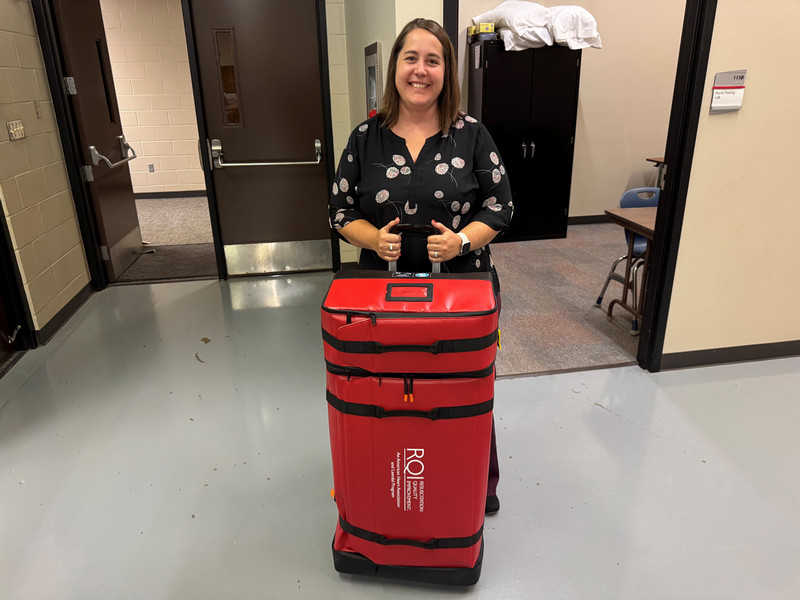
Northeast Community College had more than 5,000 students take some type of life support class and earn certifications during the 2024-25 academic year.
Northeast offers classes in everything from lay level (everyday person) to advanced cardiac life support (paramedics and hospital emergency room personnel). The courses are delivered from two organizations, American Heart Association and American Red Cross.
Heather Claussen, Director of Allied Health Programs at Northeast Community College, oversees dozens of classes across a wide range of CPR/AED and First Aid disciplines. It is the dedicated faculty who are the true backbone of the programs - bringing their expertise, passion, and commitment to the classroom every day to ensure students receive high-quality instruction and hands-on learning experiences.
So why would someone take hands only CPR? Claussen said some people don’t believe they have a need for the full certification, or don’t want to do the breaths but still want to know what to do in an emergency. Few people just want to be standing around without any idea of what to do if an emergency happens in their presence.
CPR and other life support courses are offered in Norfolk and South Sioux City primarily, but also O’Neill and West Point according to demand. Those who teach them include schoolteachers, nutritionists, firefighters, nurses and physicians, and others who work in the healthcare industry.
“We have all types of instructors who bring all types of different experiences,” Claussen said. “Most of the classes take a couple of hours, to all day, depending on the certification. And we do have a couple of classes that are two days’ long.”
Northeast has about 175 CPR instructors across its 20-county service area. Classes are offered year-round.
The classes are independent of each other, meaning there isn’t a progressive order that must be followed. The exception is some of the classes do have perquisites, such as advanced cardiac life support, which requires attendees to be certified basic life support.
There is a charge for the courses, but the costs just cover the expenses. Programs can be accessed by going to the Northeast website, https://northeast.edu/classes/search. Under keyword, put in “CPR” or whatever class is wanted. All the courses are listed, along with various dates and locations where they are offered. Northeast will do customized training if there is a business or organization with a group that seeks the same training.
Claussen said Northeast is committed to ensuring the programs are financially sustainable by covering operational costs while being mindful of the cost to our students and the public who take classes. Northeast has CPR manikins with the latest technology, including some that offer real-time feedback to attendees. The feedback could be such things as the rate of the compressions or if the breaths that are being put into manikins adequately to make sure they are being performed properly.
Those who administer breaths are given face shields -- a very thin layer of plastic that helps to protect the person administering the aid.
Northeast also offers a class hybrid, where part of the class can be taken online, and then the skills demonstrated in person.
“We even have these awesome voice-assisted manikins where you can do it all with a computer,” she said.
Claussen believes in communities taking care of one another. She is a volunteer EMT for the Carroll Volunteer Department, serving for nearly the past 18 years and understands the importance of people knowing CPR.
“It’s very important for everybody to know CPR,” she said. “You never know when you are going to need it.”
RQI GO Station
Heather Claussen, director of Allied Health programs at Northeast Community College, shows a suitcase or RQI GO Station that can be brought to a workplace or other area to offer CPR training on the go. Among the features it provides is real-time feedback on the users’ training.