Through Applied Research and Collaboration
NORFOLK, Neb. — Opportunities for non-traditional students, innovative applied research projects, and collaboration across multiple academic disciplines are driving continued growth at the Urban Farm at Northeast Community College.
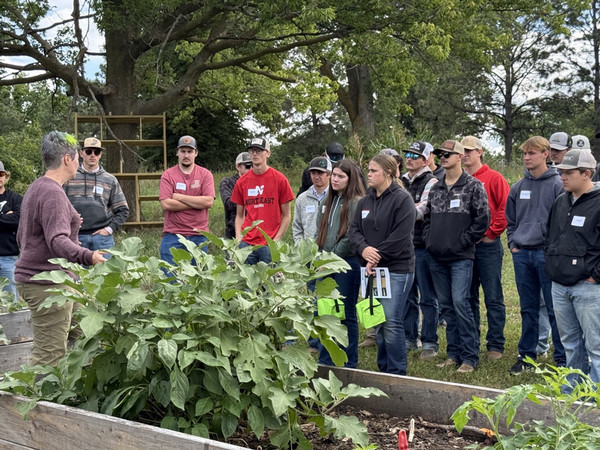
For Dr. Trentee "Tee" Bush, horticulture professor at Northeast, the 10-acre site is much more than a farm. It is an outdoor learning laboratory where students gain hands-on experience, test ideas through applied research, and discover the many ways agriculture intersects with careers beyond traditional production agriculture.
"It's meant to be a learning landscape," Bush said. "Students can learn by doing, experimenting, making mistakes, and gaining the confidence they'll need in their careers."
The Urban Farm has evolved significantly since its establishment in 2021. More than 100 fruit and nut trees native to the Great Plains and Missouri River Valley region have been planted on the site, creating an orchard designed to thrive in Northeast Nebraska's climate while providing future educational and community engagement opportunities.
Bush said the College selected species that belong in the region and can serve as examples of sustainable urban agriculture practices. Each tree has been geo-tagged, so it can be easily identified in the future, even if the original physical tag falls off.
The site also features 12 ADA-accessible raised beds that support ongoing applied research into soil health, plant performance, and sustainable growing methods. The beds contain different growing systems, including traditional soil, hugelkultur-style layering, and biochar amendments, allowing students and faculty to compare how crops respond to varying conditions.
Additional materials incorporated into the beds include grass clippings and tree-pruning debris from the Northeast grounds crew, cardboard, coffee grounds from the Union 73 coffee shop, and spent mushroom-growing blocks provided by Midwest Mushrooms, helping demonstrate how readily available materials can be repurposed to improve soil quality.
Future applied research projects may compare crop performance among the different growing systems. Bush said the College eventually hopes to evaluate crops such as tomatoes under varying compost and soil-management conditions while continuing to explore ways to improve water-use efficiency.
One emerging project involves a partnership with Colorado State University, which is providing water-sensor technology that could allow individual raised beds to receive irrigation only when needed. The technology may also support future student-led applied research projects.
"We're hoping to install those in the raised beds so that every bed will have sensors and be very efficient with its water use," Bush said. "Only that bed receives water when it needs it instead of turning all 12 of them on every day."
In addition to vegetables, the Urban Farm includes developing perennial crops such as rhubarb and asparagus and will eventually feature a native bee habitat designed to support Nebraska pollinators. Bush also hopes the public will one day enjoy access to fruits, nuts, and other products grown on the site through a self-harvest model supported by online harvest calendars and educational resources.
While the Urban Farm showcases innovative growing methods, Bush believes one of its greatest strengths is the opportunity it provides for non-traditional students.
Northeast's Urban Agriculture degree has already produced two graduates, both adult learners seeking careers that offer flexibility and broad applicability. The degree combines existing agriculture and horticulture coursework into a program focused on applying agricultural principles in urban and suburban settings.
"Both have been non-traditional students, and I think it fit them perfectly because they had a lot of life experiences," Bush said. "They kind of understood this concept of, 'I want a degree that can travel with me and be flexible in any community that I live in.'"
Graduates could pursue career opportunities ranging from golf course management to parks and recreation, community gardens, landscaping, and educational programming. Bush believes the versatility of the degree makes it particularly attractive to students pursuing a second career or a new professional direction.
"I think horticulture is a great empty-nest or second career for people because there's just so much flexibility in it," she said. "You can start a lawn-care business in your 50s if you want to and be very successful at it."
The Urban Farm is also becoming a hub for collaboration across the College.
Among the newest additions is a teaching garden developed by Bob Noonan, professor of Diversified Agriculture at Northeast. Through staggered plantings of corn, students can observe multiple crop-growth stages at the same time, from newly germinated plants to mature crops. The garden also includes heritage corn varieties and cover crops not commonly seen in Nebraska.
Bush said bringing together students and faculty from different disciplines is central to the Urban Farm's mission.
"The whole goal is to be a cross-collaboration site," she said. "I don't want just horticulture students to use it. I want students in agriculture, biology, engineering, and other programs to use it.”
Engineering students and faculty are already collaborating on the water-sensor project, and Bush hopes to engage more students from biology and other programs as additional applied research opportunities emerge. Community organizations also are using the site for educational workshops and demonstrations, including pruning workshops conducted with the Nebraska Forest Service and mushroom inoculation workshops with Midwest Mushrooms.
"The cross-collaboration gets me excited because there are so many ways that agriculture impacts other career fields that we should be having those intersections," Bush said.
As the Urban Farm continues to mature, Bush sees it becoming an increasingly valuable resource for students, community partners, and residents interested in learning more about sustainable urban agriculture.
"We want organizations to be able to use the site as an outdoor learning lab, and we want the community to know we are there," she said.
As the Urban Farm continues to evolve, it stands as a living example of Northeast Community College’s commitment to experiential learning, innovation, and community engagement, providing a place where students, educators, and residents can learn, collaborate, and grow together.
To learn more about the Urban Agriculture program visit northeast.edu/degree-and-programs/urban-agriculture.