Getting a college education isn’t easy, but it can be especially challenging for first-generation college students.
A first-generation college student means that a student’s parents did not complete a bachelor’s degree -- or in the case of students who live with and are supported by only one parent – that one parent did not complete a bachelor’s degree.
According to the National Center for Education Statistics, around 38% of undergraduate college students were first-generation in 2020.
Researchers have found that having a parent who graduated with at least a bachelor's degree helps students to adjust to the expectations of college life, including social aspects; as well as handling the pressure of being the first in the family to attend college.
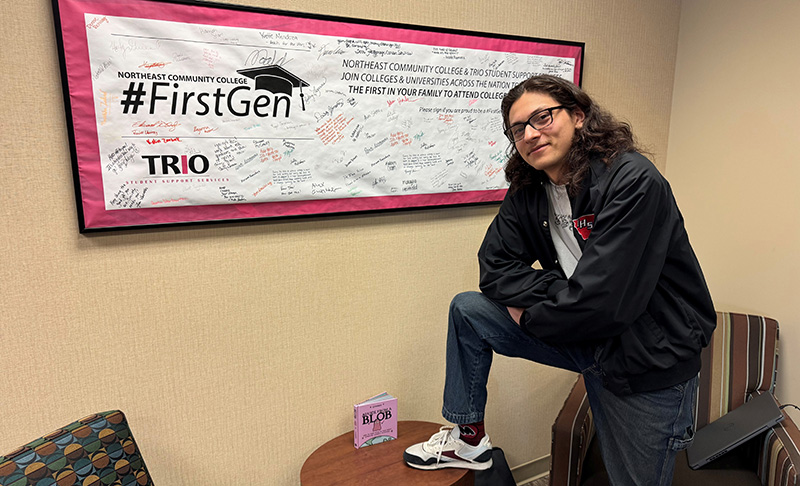
Jonathan Castro is a first-generation student at Northeast, majoring in Information Technology (IT). Casto is scheduled to graduate in May 2026.
He didn’t go to college immediately after high school, recognizing that he wasn’t ready emotionally for college. He became interested in IT after playing games on his phone and Xbox while growing up.
“I liked the fun side of it and I thought, ‘Why not make it a career and learn the technical aspects of it?’”
Castro was born in Las Vegas, then his parents and the rest of his family moved to Nebraska for his dad’s work in 2014 when he was 13. They had family and friends in Nebraska. They later traveled to Texas to visit a relative, and his mother and a cousin were killed in a car accident. As a result, his dad and brothers moved back to Las Vegas temporarily but then decided to return to Nebraska.
After high school, Castro didn’t go to college immediately, working at a few jobs including Walmart, where he still works while attending Northeast. Walmart has been a great job for him, he said, but he decided he wanted to go to college to improve things for his family and if he ever has children.
“Every Hispanic who moves here works his tail off in hopes to build a foundation for the next generation,” Castro said. “I want to provide for not only my current family, but the family I want to build.”
Castro, who is the second oldest and maintains at least a 3.5 grade point average, lives with his father and his younger brothers. He and his older brother help with the younger brothers, and he wants them to have it as good as possible.
His dad and older brother offered to pay for his college, but Castro declined.
“I don’t want to be more of a burden than I already am,” he said.
Castro has received some financial help and services, including from the Northeast TRIO Office.
“If it wasn’t for TRIO and financial aid, I would not be in college,” Castro said.
TRIO helps in a variety of ways, including emotional support, helping to set up schedules and signing up for financial aid.
“It’s kind of scary because I come from a family where nobody went to college,” he said. “I had a lot of uncertainty because I didn’t know how this all worked.”
First Generation College Day is observed on November 8 each year. The date commemorates the signing of the Higher Education Act of 1965, which expanded federal financial aid and support for students to attend college.
Castro said he hopes to work for a company after graduation that will pay for some or all the costs to get his four-year degree. Beyond that, Castro said college has taught him the importance of learning, and he hopes to keep his mind in a frame where he will be open to learning for the rest of his life.
Still, getting a degree has its challenges. Some days it is easy to get discouraged.
“One fear I have is the Latino dropout rate is the highest,” Castro said. “That kind of instills fear in me, but it also instills determination. I’m like, ‘I am not going to be another one who is part of a statistic.’”
First-generation student
Jonathan Castro is a first-generation student who is scheduled to graduate in May from Northeast Community College, with an associate’s degree in information technology. According to the National Postsecondary Student Aid Survey, first-generation students were more likely to attend public two-year institutions than other colleges, with Latinos having the highest first-generation students. (Northeast Community College)
###