Most landowners do research before purchasing farm ground.
It helps them to know what the land can produce and whether it will be safe for animals or humans to consume the produce.
That same principle applies to urban agriculture – albeit on a much smaller scale. During a recent Agronomy Day at Northeast Community College, one of the seven sites for students to visit was the Northeast Urban Farm, and one of the topics covered was learning about the history of the land.
Students learned about specialized equipment that can be used to conduct tests to determine if there are heavy metals or minerals present that could impact fruits and vegetables raised on the ground.
Tyler Durre from the USDA Natural Resources Conservation Service discussed the scans and demonstrated the equipment. Tests also can determine if there are lethal amounts of lead or arsenic in the soil.
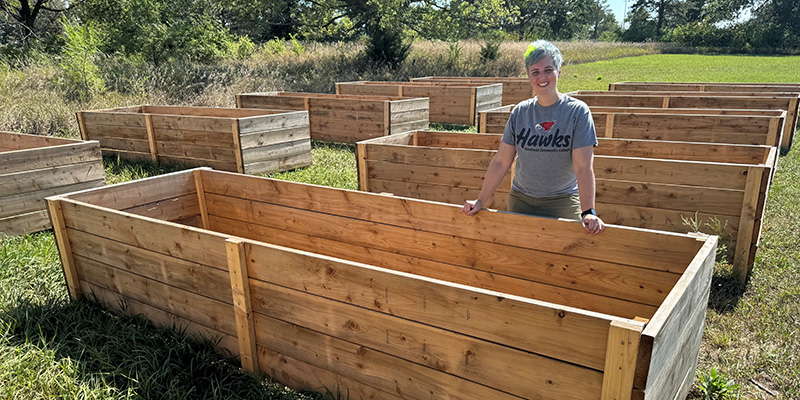
With urban agriculture, there are fixes to high levels of lead or arsenic in soil, for example. The produce can be raised in a raised bed, with a root barrier kept under it. In some situations, it might be feasible to scrape off the contaminated soil and replace it with new, healthy topsoil.
Part of the Northeast Community College 10-acre Urban Farm has an area that was used as an incinerator before Northeast owned the property. That area has tested high for lead content.
Durre said he learned about soil scanning when he was working in Connecticut. They have been doing soil scanning for a while, in part because that area was settled more than a century before this part of the country.
“New York was kind of the leader in it (soil scanning), along with New Jersey, followed by Connecticut,” he said.
Nebraska is in a pilot project with it, with the results not shared with any regulatory agencies. Instead, those who might bring in a baggie of soil to be tested are informed about best management practices.
Tee Bush, an agriculture and agronomy instructor, said Northeast will test the honey that bees at the site are producing to determine if any metals show up in the honey.
“These are the kinds of things that maybe have never been thought about before,” Bush told the students.
The Urban Garden is being planned and put together. All the projects take planning and money, Bush said, with ideas that include a garden, some in-ground production, various growth stages of plants for identification purposes, mushroom inoculation, among other things.
Jill Heemstra, director of the Northeast Ag program, said there is growing interest in raising food and urban agriculture. Heemstra said the interest in the Northeast Urban Farm includes Ag alumni, who are interested in such things as a raised garden, even if they don’t work in agriculture now.
Northeast has an intern working on its urban farm, Chrissy Clark, who originally is from California. She is an Urban Agriculture major at Northeast and is excited about what the urban farm’s potential is.
“As a student, I love the idea of going out and physically touching what we are learning about in the classroom,” Clark said, “and having a real education in that sense. As a community member, I love that I have the opportunity to come out and continue my education. Everything is here in this small plot.”
Clark said her husband is in the military, so they have had to move around a lot. That is one of the reasons why urban agriculture interests her.
“I love the idea of growing my own food,” she said, “and understanding what goes into everything and learning about what to look forward to growing at each place.”
Tee and Raised Beds
Tee Bush, who has a doctorate in education and master’s degree in horticulture, shows one of the raised beds where produce can be grown at the Urban Farm. (Northeast Community College)
###