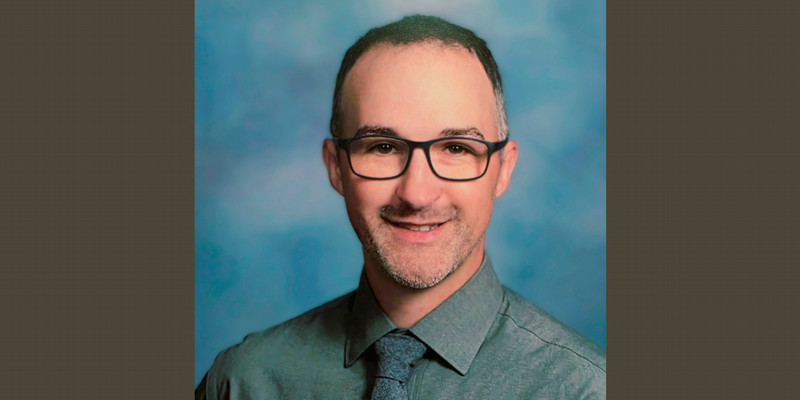
To say that school was hard for Northeast Community College alum Lee Embley would be an understatement.
He struggles with an ADHD diagnosis and a math learning disability that make learning slow and painful. So just how did Lee end up teaching integrated science to eighth grade students at Norfolk Junior High?
Lee’s career path was not traditional, and anything but a straight line. After graduating from West Holt High School in Atkinson at the age of 17, he moved to Norfolk to find a job. For more than 15 years, Lee worked for Cardinal Health and its predecessor companies in the plant south of Norfolk. He was a material handler at first, then worked in radiation for about 10 years.
At the urging of an important person in his life, Lee decided to try college.
“I originally came to Northeast for computer science,” he said. “But I gained 20 pounds just sitting there programming.”
And because of his math learning disability, learning coding was difficult for him.
After computer science, Lee tried respiratory therapy.
“I’m a father,” he said, “and I just couldn’t deal with children in those situations.”
Lee has four children, ages 16, 14, 11 and 9.
At Cardinal, Lee had taken on the responsibility of training employees for random jobs after other trainers had failed to reach them.
“So I was dealing with adults that very clearly had a learning disability,” Lee said. “The job hadn’t been explained to them in a way that worked for them, so I was like ‘Let’s figure this out, let’s color code something, let’s get the math down.’ And I found that when they got something and the light bulb would come on, I really liked that.”
The realization that he liked helping others learn brought Lee back to Northeast, this time to be a secondary science teacher. He was certainly a non-traditional student, at least 15 years older than most of the other students in his classes.
“It was really weird to be going to school with people who did not remember 9-11,” he said. “That was such a formative thing that the world went through and to have kids say ‘Yeah, I read about that’ or ‘my parents told me about that’ was strange.”
Lee said he also took learning more seriously as an adult than he had as a teenager.
“I was a horrible student when I was young,” he shared. “I failed several classes in high school. When I came back as an adult, I did have some scholarships and financial aid, but I took it very seriously. This was about money, so I treated it like a job.”
Because of his learning disabilities, Lee was able to access disability services during his second year at Northeast and also qualified for TRIO SSS, a federally funded program for first generation or low-income students and those with disabilities. He was selected to represent Northeast on a TRIO trip to Georgia which, unfortunately, was cancelled because of COVID. He did receive academic support from TRIO, including an iPad for use in his classes.
Lee credits several of his teachers for helping him get through college level classes.
“The teachers at Northeast are what made the difference,” he said. “Mary O’Boyle is so awesome. And Angie Jackson was humorous and active. If she is showing you what is going on in your body, she is running around the room pretending to be different parts of the cell.”
Lee also mentioned physics and chemistry instructors David Heidt and Kim Timperley.
“Mr. Heidt allowed three chances on quizzes,” Lee said, “and he completely worked out the problems you missed to show what you had done wrong. I learn more from making mistakes than I do with being right the first time, so that was very formative for me. I use that with my students now.”
Lee graduated from Northeast in 2020 with an associate's degree in biology and from Wayne State College in 2023 with his bachelor’s degree. He was hired to teach integrated science at Norfolk Junior High that spring and completed his second year of teaching in May.
“On day one, I am honest with my students,” Lee said. “I tell them I have ADHD and I’m the teacher who might be teaching you about the earth spinning on its axis while I am spinning around like a ballerina. I’m very high energy, but I’m also very forgetful. If a student asks me to do something, I will ask them to please follow me to my computer and watch while I write an email or do a post-it note.”
Lee said he tries to help his students accept those with learning disabilities and to help those with a disability diagnosis to better understand that “life is not hopeless just because they don’t understand what is going on right now. You can do this – it’s just hard.”
He also talks with students about self-advocacy.
“They come up to me and say, ‘This teacher is so mean to me and I don’t think they like me.’ We sit down and write a script that they can think about and then go talk with the teacher. I didn’t have anyone to teach me to self advocate. I thought my teachers hated me and I just gave up.”
Lee said having learning disabilities makes him a better teacher, but it also makes teaching difficult at times.
“Despite everything I have tried,” he explained, “I’m still disorganized. My first year of teaching I would lose my computer mouse all the time. So now I have three strategically placed mice in my room.
“It is akin to being left-handed,” Lee said of his learning disabilities. “The world is not set up for left-handed people. Scissors just don’t work well for left-handed people, so they learn to use their right hand, bring their own left-handed scissors, or make them work awkwardly with their left hand. Learning for students with a disability might be ugly, but it is manageable.”
Lee said the support he received at Northeast through Disability Services, TRIO, and his instructors made it possible for him to get a bachelor’s degree and his dream job.
“We have a college visit for my junior high students,” he said, “and I always tell them if you are thinking about going to a four-year college, start at Northeast, do your generals here. Everybody is awesome, it’s cheaper. Just be sure your credits transfer on to the next college.”
Any student interested in learning more about Northeast Community College may visit northeast.edu/admissions.
Northeast Community College encourages all alumni to share their stories by visiting northeast.edu/giving/alumni.
###
ID: Lee Empley
Please Note: This article is part of a series of features dedicated to sharing the significant success of students through Northeast Community College’s federally-funded TRiO Student Support Services (SSS) program, a program that is currently facing elimination in President Trump’s proposed FY 2026 budget.
A program for low-income, first-generation students and individuals with disabilities, Northeast’s TRiO SSS program stands as one of the most successful in the nation, boasting a 98% fall-to-fall persistence rate. In addition, 88% of Northeast TRiO SSS students graduate, compared to the national average of 39% for all community college students. Additionally, 98% of Northeast’s TRiO students maintain a GPA of 2.0 or higher.
Members of the public are asked to consider contacting their Congressional offices to voice their concerns about cuts or elimination of important higher education programs such as TRiO and Pell grants.
To view all the stories, graphics and photos in this series, please click here to be linked to the Northeast website. https://northeast.edu/giving/feature-stories