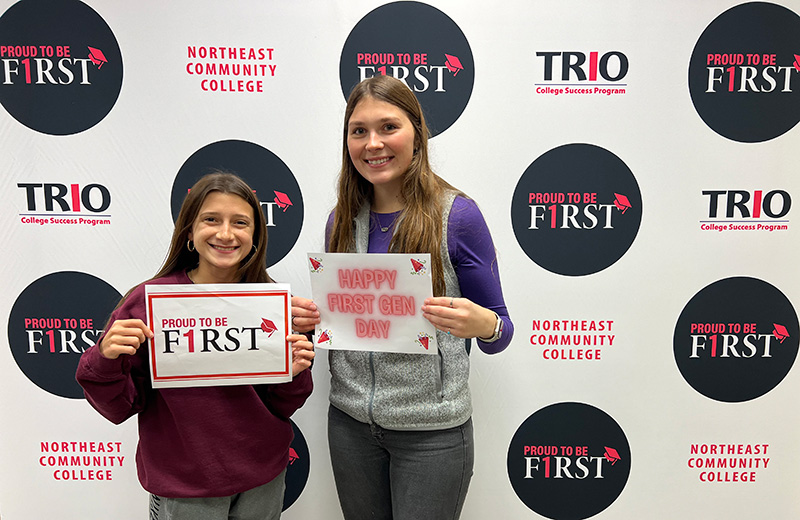
Getting students to – and through – college is the goal of the federal TRIO-SSS program.
TRIO provides support services to first generation and low-income students, as well as to those with disabilities.
TRIO has its roots in the Economic Opportunity Act of 1964 and the Higher Education Act of 1965, when Upward Bound and Talent Search were established. Upward Bound is campus- based and provides intensive mentoring and support for students to prepare for college entrance exams and tackle admission applications, financial aid, and scholarship forms.
Talent Search focuses on early intervention, working with students in grades 6-12. With the addition of Student Support Services in 1968, the name “TRIO” was ushered in. Student Support Services (SSS) provides tutoring, counseling, and remedial instruction to help students achieve college completion goals.
Several other programs have joined TRIO since then, including Educational Opportunity Centers for displaced or underemployed workers, Veterans Upward Bound, Upward Bound Math-Science, and the Ronald E. McNair Post Baccalaureate Achievement program to support doctoral study and help students pursue careers in college teaching.
TRIO-Student Support Services began at Northeast Community College in 2015, and since then, more than 800 students have benefited from TRIO support at Northeast. Annually, up to 200 students are supported by TRIO-SSS at Northeast, but more than 100 students remain on the wait list each year.
Josh Becker is the director of TRIO – College Success Program at Northeast. Becker said the program offers personal success coaching, community building, intensive advising at least three times a semester, and more.
"That intensive advising offers students a relationship with an adviser, someone they know they can go to whenever they have questions, whenever they have concerns," Becker said. "We also have free technology for our students, so we can get every single one of our students a free laptop, iPad, voice recorders, certain kinds of software for the computer, headphones, calculators, things that can help them out in the classroom."
The TRIO Program provides these services to students free of charge through a five-year federal grant. The last grant was awarded to Northeast in 2020 for $261,000 per year, or a total of more than $1.3 million over the five-year period.
By offering comprehensive support services, TRIO-SSS plays a crucial role in increasing retention and graduation rates among disadvantaged students. Last year, Northeast TRIO students had a 97% persistence rate, meaning that only 3% of students in the TRIO program at Northeast did not continue their education from fall to fall.
At Northeast, 98% of TRIO students maintained a grade point average of 2.0 (C) or better, and 88% graduated, compared to an average national graduation rate at two-year institutions of 35% and the overall graduation rate at Northeast of 51.6%.
TRIO-SSS aligns with bipartisan goals of increasing college completion rates, workforce development, economic growth, and reducing achievement gaps. By increasing graduation rates, TRIO-SSS ensures higher tax revenues, lower dependence on social services, and stronger economic growth.
Unique aspects of the TRIO-SSS program are an academic support system that provides tutoring, study skills workshops, and academic advising; financial literacy and assistance programs to help students overcome economic barriers that hinder their academic progress; and creation of a sense of community and belonging, especially for first-generation students who may feel isolated in a college setting.
Becker said the benefits that come from the program stay with Northeast graduates after they leave the institution.
“TRIO alumni at Northeast have gone on to do amazing work in their respective fields and continue to further their postsecondary education at many different four-year colleges and universities,” Becker said. “TRIO staff consider ourselves fortunate to have been a small part of so many different students’ success.”
One of the most famous TRIO alums is EGOT-winning actress Viola Davis. She and three of her sisters made use of TRIO-SSS support to enter and successfully complete college.
“Upward Bound and the preparatory program made me a citizen of the world,” Davis said. “It gave me perspective, and it made me feel like my situation and my environment didn’t define me.”
The Davis family received the TRIO Family Achievement Award from the Council for Opportunity in Education in 2018.
For the TRiO students:
Please Note: This article is part of a series of features dedicated to sharing the significant success of students through Northeast Community College’s federally-funded TRiO Student Support Services (SSS) program, a program that is currently facing elimination in President Trump’s proposed FY 2026 budget.
A program for low-income, first-generation students and individuals with disabilities, Northeast’s TRiO SSS program stands as one of the most successful in the nation, boasting a 98% fall-to-fall persistence rate. In addition, 88% of Northeast TRiO SSS students graduate, compared to the national average of 39% for all community college students. Additionally, 98% of Northeast’s TRiO students maintain a GPA of 2.0 or higher.
Members of the public are asked to consider contacting their Congressional offices to voice their concerns about cuts or elimination of important higher education programs such as TRiO and Pell grants.
To view all the stories, graphics and photos in this series, please click https://northeast.edu/giving/feature-stories.
###